>
Perciformes/Uranoscopoidei (Sand dwellers) >
Ammodytidae (Sand lances)
Etymology: Bleekeria: He researched the fishes from India and Malaysia, 1862-1878 (Ref. 45335); mitsukurii: Although not specified in the original description, the specific epithet "mitsukurii" is honouring Kakichi Mitsukuri (1857-1909) zoologist and professor at the Imperial University of Tokyo.
Eponymy: Dr Pieter Bleeker (1819–1878) was an ichthyologist and army surgeon commissioned (1841) by the Dutch East India Company. [...] Dr Kakichi Mitsukuri (1857–1909) was a Japanese zoologist who first went to the USA (1873) and achieved doctorates from Yale (1879) and from Johns Hopkins University (1883). [...] (Ref. 128868), visit book page.
More on authors: Jordan & Evermann.
Milieu: milieu / Klimaatzone / Diepte / verspreidingsgebied
Ecologie
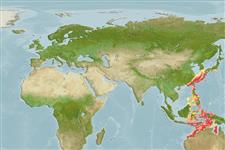
marien benthopelagisch; diepte 56 - 217 m (Ref. 86942). Tropical; 36°N - 21°S, 116°E - 140°E (Ref. 57360)
Indo-Pacific: central Japan to the South China Sea. Recorded from Indonesia and northwestern Australia (Ref. 5978) and from the Chesterfield Islands (Ref. 11897); also occurs in the western Indian Ocean (Ref. 7068).
Grootte / Gewicht / Leeftijd
Maturiteit: Lm ? range ? - ? cm
Max length : 16.0 cm TL mannelijk / geslacht onbekend; (Ref. 637)
Korte beschrijving
Determinatiesleutels | Morfologie | Morfometrie
Dorsale zachte stralen (totaal) : 37 - 42; Anale zachte stralen: 14 - 16; Wervels: 50 - 56. This species is distinguished by having teeth in jaws; scales on central part of body of equal length and height; when fresh caudal fin colouration dusky with black-edged yellow inner margin (Ref. 123825).
Cross section: oval.
Schools in shallow waters on sandy bottom, diving into the sand when threatened (Ref. 637). Probably taken by trawl net and handnet (Ref. 123825).
Levenscyclus en paargedrag
Maturiteit | Voortplanting | Paaien | Eieren | Fecunditeit | Larven
Collette, B.B., 2001. Ammodytidae. Sandlances. p. 3518. In K.E. Carpenter and V. Niem (eds.) FAO species identification guide for fishery purposes. The living marine resources of the Western Central Pacific. Vol. 6. Bony fishes part 4 (Labridae to Latimeriidae), estuarine crocodiles. FAO, Rome. (Ref. 10275)
Status op de Rode Lijst van het IUCN (Ref. 130435: Version 2025-2 (Global))
Gevaar voor de mens
Harmless
Gebruik door de mens
Visserij: bycatch
Tools
Speciale rapporten
Download XML
Internetbronnen
Schattingen op basis van modellen
Gewenste temperatuur (Ref.
123201): 18.4 - 27.6, mean 24.4 °C (based on 190 cells).
Fylogenetische diversiteitsindex (Ref.
82804): PD
50 = 0.5039 [Uniqueness, from 0.5 = low to 2.0 = high].
Bayesian length-weight: a=0.00324 (0.00142 - 0.00739), b=3.07 (2.88 - 3.26), in cm total length, based on LWR estimates for this (Sub)family-body shape (Ref.
93245).
Trofisch niveau (Ref.
69278): 3.2 ±0.4 se; based on size and trophs of closest relatives
Weerstandsvermogen (Ref.
120179): Hoog, minimale populatieverdubbelingstijd minder dan 15 maanden (Preliminary K or Fecundity.).
Kwetsbaarheid van de visserij (Ref.
59153): Low vulnerability (10 of 100).
🛈