>
Acropomatiformes (Oceanic basses) >
Malakichthyidae (Temperate ocean-basses)
Etymology: Malakichthys: Greek, malakia = softness + Greek, ichthys = fish (Ref. 45335).
Eponymy: Dr Yohiro (also spelt Yojiro) Wakiya was superintendent of the Korean Government Fisheries Experiment Station. He was honoured in the gudgeon’s trinomial for his help in the preparation of Mori’s paper. He collected the seabass holotype. (Ref. 128868), visit book page.
More on authors: Jordan & Hubbs.
Umwelt: Milieu / Klimazone / Tiefenbereich / Verbreitungsgebiet
Ökologie
seewasser pelagic-neritic; tiefenbereich ? - 200 m (Ref. 11230). Temperate
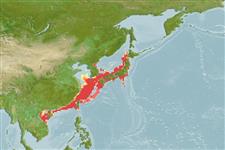
Northwest Pacific: southern Japan, the East China Sea and around Taiwan.
Größe / Gewicht / Alter
Geschlechtsreife: Lm ? range ? - ? cm
Max length : 15.0 cm TL Männchen/unbestimmt; (Ref. 637)
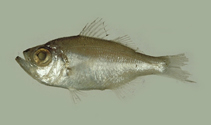
Rückenflossenstacheln (insgesamt) : 9 - 10; Rückenflossenweichstrahlen (insgesamt) : 10; Afterflossenstacheln: 3; Afterflossenweichstrahlen: 8 - 9; Wirbelzahl: 10 - 15. This species has the following characters: chin with a pair of distinct spines; proximal-middle radial of first anal-fin pterygiophore slender with no hollow; well developed lateral wing; 13 (rarely 12) pectoral-fin rays; A III, 9 (rarely 8); longest anal-fin ray is shorter than half of base of anal fin; body depth 34-41% LS; lateral line scales 48-51; gill rakers 22-24 on lower arm (Ref. 76883). Body uniformly brownish-silver dorsally, white ventrally (Ref. 559).
Body shape (shape guide): elongated; Cross section: compressed.
Feeds on small crustaceans and fishes, among others (Ref. 559). Caught in depths of less than 150 m (Ref. 637).
Lebenszyklus und Paarungsverhalten
Geschlechtsreife | Fortpflanzung | Ablaichen | Eier | Fruchtbarkeit | Larven
Masuda, H., K. Amaoka, C. Araga, T. Uyeno and T. Yoshino, 1984. The fishes of the Japanese Archipelago. Vol. 1. Tokai University Press, Tokyo, Japan. 437 p. (text). (Ref. 559)
IUCN Rote Liste Status (Ref. 130435: Version 2025-2 (Global))
Bedrohung für Menschen
Harmless
Nutzung durch Menschen
Tools
Zusatzinformationen
Download XML
Internet Quellen
Schätzungen auf der Grundlage von Modellen
Bevorzugte Temperatur (Ref.
123201): 11.9 - 22.2, mean 18.5 °C (based on 126 cells).
Phylogenetischer Diversitätsindex (Ref.
82804): PD
50 = 0.5039 [Uniqueness, from 0.5 = low to 2.0 = high].
Bayesian length-weight: a=0.00468 (0.00181 - 0.01207), b=3.12 (2.89 - 3.35), in cm total length, based on LWR estimates for this (Sub)family-body shape (Ref.
93245).
Trophische Ebene (Ref.
69278): 4.0 ±0.66 se; based on food items.
Anfälligkeit der Fischerei (Ref.
59153): Low vulnerability (10 of 100).
🛈