>
Ovalentaria/misc (Various families in series Ovalentaria) >
Plesiopidae (Roundheads) > Acanthoclininae
Etymology: Belonepterygion: Greek, belone = needle; any fish with sharp pointed snout + Greek, pterygion, diminutive of pteryx = fin (Ref. 45335).
More on author: Ogilby.
Umwelt: Milieu / Klimazone / Tiefenbereich / Verbreitungsgebiet
Ökologie
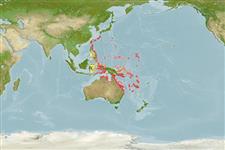
seewasser riff-verbunden; standorttreu; tiefenbereich 0 - 10 m (Ref. 90102). Temperate; 30°N - 32°S, 120°E - 169°E
Western Pacific: Japan south to Australia; east to New Caledonia.
Größe / Gewicht / Alter
Geschlechtsreife: Lm ? range ? - ? cm
Max length : 5.0 cm TL Männchen/unbestimmt; (Ref. 48635)
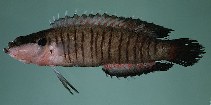
Rückenflossenstacheln (insgesamt) : 17 - 20; Rückenflossenweichstrahlen (insgesamt) : 4 - 5; Afterflossenstacheln: 10 - 12; Afterflossenweichstrahlen: 3 - 5. Similar to A. hiatti but differs by having a lateral line in 3 parts, more lateral scale rows (35-36 versus 28-30), and no spines in the operculum.
Body shape (shape guide): elongated; Cross section: oval.
Found in tidal pools around coral reefs and lagoons (Ref. 559). Benthic (Ref. 75154). Eggs are guarded by the male parent (Ref. 205). Solitary, secretive crevice dweller (Ref 90102).
Lebenszyklus und Paarungsverhalten
Geschlechtsreife | Fortpflanzung | Ablaichen | Eier | Fruchtbarkeit | Larven
Eggs are guarded by the male parent (Ref. 205).
Paxton, J.R., D.F. Hoese, G.R. Allen and J.E. Hanley, 1989. Pisces. Petromyzontidae to Carangidae. Zoological Catalogue of Australia, Vol. 7. Australian Government Publishing Service, Canberra, 665 p. (Ref. 7300)
IUCN Rote Liste Status (Ref. 130435: Version 2025-2 (Global))
Bedrohung für Menschen
Harmless
Nutzung durch Menschen
Fischereien: nicht kommerziell
Tools
Zusatzinformationen
Download XML
Internet Quellen
Schätzungen auf der Grundlage von Modellen
Bevorzugte Temperatur (Ref.
123201): 24.9 - 29.4, mean 28.5 °C (based on 1111 cells).
Phylogenetischer Diversitätsindex (Ref.
82804): PD
50 = 1.0000 [Uniqueness, from 0.5 = low to 2.0 = high].
Bayesian length-weight: a=0.00468 (0.00181 - 0.01207), b=3.11 (2.88 - 3.34), in cm total length, based on LWR estimates for this (Sub)family-body shape (Ref.
93245).
Trophische Ebene (Ref.
69278): 3.3 ±0.6 se; based on size and trophs of closest relatives
Widerstandsfähigkeit (Ref.
120179): hoch, Verdopplung der Population dauert weniger als 15 Monate. (Preliminary K or Fecundity.).
Anfälligkeit der Fischerei (Ref.
59153): Low vulnerability (10 of 100).
🛈
Nährstoffe (Ref.
124155): Calcium = 83.5 [28.5, 183.8] mg/100g; Iron = 0.36 [0.17, 0.74] mg/100g; Protein = 18.7 [17.3, 20.0] %; Omega3 = 0.277 [0.114, 0.660] g/100g; Selenium = 4.46 [1.39, 12.91] μg/100g; VitaminA = 111 [22, 568] μg/100g; Zinc = 1.24 [0.69, 2.19] mg/100g (wet weight);