Пластиножаберные (акулы и скаты) (sharks and rays) >
Torpediniformes (Electric rays) >
Platyrhinidae (Fanrays)
Etymology: Platyrhina: Greek, platys = flat + Greek, rhinos = nose. It is the same voice used for the Mammalian division made in Primates (Ref. 45335).
More on authors: Bloch & Schneider.
Окружающая среда: среда / климатическая зона / пределы глубины / диапазон распространения
экология
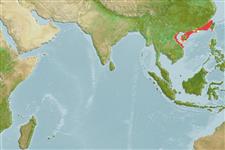
морской демерсальный; мигрирует в океане (Ref. 51243). Subtropical; 25°N - 15°N, 105°E - 120°E (Ref. 114953)
Northwest Pacific: Chinese coast of Taiwan Strait and in the South China Sea to northern Vietnamese waters; not confirmed from Japanese, South Korean or Taiwanese waters (likely to occur in Taiwan).
Размер / Вес / Возраст
половая зрелость: Lm ? range ? - ? cm
Max length : 86.3 cm TL самец/пол неопределен; (Ref. 83530); common length : 50.0 cm TL самец/пол неопределен; (Ref. 637)
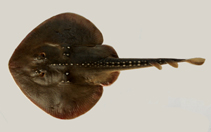
This species is distinguished from its congeners in having the following set of characters: two rows of thorns (strongly hooked and gradually becoming somewhat embedded toward first dorsal fin origin) on mid-dorsum of tail; no thorns at the anterior part of scapular region; thorns on the orbital, nape and scapular regions not encircled by light yellow or white pigment; dorsal surface covered with minute dermal denticles of uniform size and shape, no obvious larger dermal denticles (smooth to touch) (Ref. 86259).
Body shape (shape guide): other.
Found inshore (Ref. 9903), above 60 m on rock or rocky sand bottoms (Ref. 11230). Ovoviviparous (Ref. 50449). Biology little known (Ref. 9903).
Жизненный цикл и брачное поведение
половая зрелость | размножение | нерест | икра | Плодовитость | личинки
Exhibit ovoviparity (aplacental viviparity), with embryos feeding initially on yolk, then receiving additional nourishment from the mother by indirect absorption of uterine fluid enriched with mucus, fat or protein through specialised structures (Ref. 50449).
Compagno, L.J.V. and P.R. Last, 1999. Platyrhinidae. Thornback rays. p. 1431-1432. In K.E. Carpenter and V.H. Niem (eds.) FAO identification guide for fishery purposes. The living marine resources of the Western Central Pacific. Rome, FAO. (Ref. 9903)
Статус Красного Списка МСОП (Ref. 130435: Version 2025-2 (Global))
Использование человеком
рыболовство: bycatch
дополнительная информация
инструменты
Специальные отчеты
Скачать в формате XML
ресурсы в Интернет
Оценки, основанные на моделях
Предпочтительная температура (ссылка
123201): 22.8 - 26.7, mean 25.2 °C (based on 112 cells).
Индекс филогенетического разнообразия (ссылка
82804): PD
50 = 0.5938 [Uniqueness, from 0.5 = low to 2.0 = high].
Bayesian length-weight: a=0.01000 (0.00244 - 0.04107), b=3.04 (2.81 - 3.27), in cm total length, based on all LWR estimates for this body shape (Ref.
93245).
Трофический уровень (ссылка
69278): 3.5 ±0.37 se; based on food items.
устойчивость к внешним воздействиям (ссылка
120179): низкий, минимальное время удвоения популяции 4.5-14 лет (Fec assumed to be <100).
Уязвимость рыбной ловли (Ref.
59153): Moderate to high vulnerability (55 of 100).
🛈