>
Tetraodontiformes (Puffers and filefishes) >
Ostraciidae (Boxfishes)
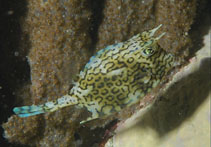
Etymology: Acanthostracion: Greek, akantha = thorn + Greek, ostrakon = shell (Ref. 45335); quadricornis: Specific name refers to the 2 pairs of horns ('quadricornis' = 4 horns), in front of the eyes and a second pair at the lower rear corners of the cuirass.
More on author: Linnaeus.
Ambiente: milieu / zona climática / intervalo de profundidade / gama de distribuição
Ecologia
marinhas associadas(os) a recifes; intervalo de profundidade 1 - 80 m (Ref. 26938), usually 10 - 30 m (Ref. 40849). Subtropical; 43°N - 39°S, 100°W - 26°E
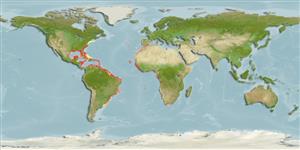
Atlantic Ocean: in tropical and temperate waters (Ref. 3696). Western Atlantic: Massachusetts (USA), Bermuda, and northern Gulf of Mexico to southeastern Brazil. Reported from tip of South Africa.
Comprimento na primeira maturidade / Tamanho / Peso / Idade
Maturidade: Lm 22.2, range 17 - ? cm
Max length : 55.0 cm TL macho/indeterminado; (Ref. 6937); common length : 20.0 cm TL macho/indeterminado; (Ref. 3696)
Espinhos dorsais (total) : 0; Raios dorsais moles (total) : 10; Espinhos anais: 0; Raios anais moles: 10. Dark markings on head and body; parallel bands on cheek. Pair of prominent spines projecting from in front of eyes suggests cow horns. Second pair of spines at lower rear corners of cuirass (Ref. 26938). Body deep, covered with hexagonal dermal plates (Ref. 37521).
Body shape (shape guide): short and / or deep.
Found in shallow water down to about 80 m, mainly in seagrass beds (Ref. 3696). Feeds on sessile invertebrates such as tunicates, gorgonians and anemones, as well as on slow-moving crustaceans, sponges (Ref. 3696), hermit crabs and marine plants (Ref. 13442). Oviparous (Ref. 205). Considered an excellent food fish; marketed fresh (Ref. 3696).
Smith, M.M., 1986. Ostraciidae. p. 890-893. In M.M. Smith and P.C. Heemstra (eds.) Smiths' sea fishes. Springer-Verlag, Berlin. (Ref. 3141)
Categoria na Lista Vermelha da IUCN (Ref. 130435: Version 2025-2 (Global))
Ameaça para o homem
Reports of ciguatera poisoning (Ref. 30303)
Utilização humana
Pescarias: pouco comercial; Aquário: Espécies comerciais
Ferramentas
Relatórios especiais
Descarregue XML
Fontes da internet
Estimativas baseadas em modelos
Temperatura preferida (Ref.
123201): 22.3 - 28, mean 25.4 °C (based on 458 cells).
Índice de diversidade filogenética (Ref.
82804): PD
50 = 0.5625 [Uniqueness, from 0.5 = low to 2.0 = high].
Bayesian length-weight: a=0.04169 (0.02492 - 0.06973), b=2.69 (2.54 - 2.84), in cm total length, based on LWR estimates for this species & (Sub)family-body (Ref.
93245).
Nível Trófico (Ref.
69278): 2.7 ±0.2 se; based on diet studies.
Resiliência (Ref.
120179): Elevada, tempo mínimo de duplicação da população menor que 15 meses (Fec = 112,536).
Vulnerabilidade da pesca (Ref.
59153): Moderate vulnerability (42 of 100).
🛈
Nutrientes (Ref.
124155): Calcium = 22.3 [9.0, 63.2] mg/100g; Iron = 0.615 [0.308, 1.471] mg/100g; Protein = 18.8 [16.5, 21.0] %; Omega3 = 0.153 [0.077, 0.296] g/100g; Selenium = 24 [10, 55] μg/100g; VitaminA = 18.4 [4.2, 81.7] μg/100g; Zinc = 0.73 [0.46, 1.17] mg/100g (wet weight);