>
Eupercaria/misc (Various families in series Eupercaria) >
Lutjanidae (Snappers) > Caesioninae
Etymology: Caesio: Latin, caesius, bluish-grey, 1835; it is the same name given to the silvery metal (Cs) (Ref. 45335).
More on author: Bloch.
पर्यावरण: पर्यावरण / जलवायु क्षेत्र / गहराई सीमा / वितरण सीमा
पारिस्थितिकी
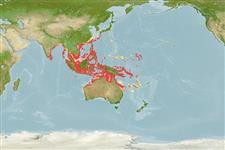
समुद्री प्रवाल-भित्ति संयुक्त; गैर प्रवासी; गहराई सीमा 1 - 60 m (Ref. 86942). Tropical; 31°N - 28°S, 76°E - 172°E (Ref. 402)
Indo-West Pacific: Sri Lanka to Vanuatu; southern Japan to northern Australia.
आकार / वज़न / आयु
परिपक्व अवधि: Lm ? range ? - ? cm
Max length : 60.0 cm TL पुल्लिंग / अलिंग; (Ref. 402)
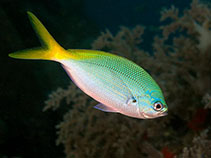
पृष्ठीय रीढ़ (सम्पूर्ण) : 10; पृष्ठीय सौफट रेज़ (सम्पूर्ण) : 14 - 16; गुदा कांटा: 3; ऐनल सौफट रेज़: 10 - 12. Deep-bodied (Ref. 48636). Scales center lighter than margins; lower 1/3 white, sometimes suffused by pink; prominent black markings on caudal fin absent. 4-5 scales on cheek; predorsal scales 20-26; scaled dorsal and anal fins. Upper peduncular scale rows 9-11; lower peduncular scale rows usually 12-14. Distinguished from C. teres in having a continuous supra-temporal band of scales across the dorsal midline. Basioccipital process for attachment of Baudelot's ligament absent. Post maxillary process single; posterior end of maxilla blunt. Color: Upper body if not yellow, grayish blue; lower sides and belly white or pinkish. Pectoral, pelvic and anal fins white to pink. Large yellow tail. Dorsal fin yellow posteriorly and grayish blue anteriorly. Length usually at 35 cm (Ref. 48636). Head length 2.8-3.6 in SL; body depth 3.0-4.2 in SL (Ref. 90102).
Body shape (shape guide): fusiform / normal; Cross section: compressed.
Often in silty areas with low visibility at 1-30 m depth (Ref. 90102). Inhabits coastal areas, usually over rocky and coral reefs. Forms schools in midwater and feeds on zooplankton. Oviparous, with numerous, small pelagic eggs (Ref. 402). Taken primarily by handline in Sri Lanka; caught mostly by fish traps in western Thailand and Malaysia; caught in trawls in the Gulf of Thailand; caught by a variety of methods including drive-in nets, fish traps and gill nets in Indonesia, the Philippines and Papua New Guinea. The most ancestral living caesionid species.
जीवन चक्र और संभोग व्यवहार
परिपक्व अवधि | पुनरुत्पत्ति | मछलीऔ का अंडे देना | अंडे | उपजाऊपन | लार्वा
Carpenter, K.E., 1987. Revision of the Indo-Pacific fish family Caesionidae (Lutjanoidea), with descriptions of five new species. Indo-Pac. Fish. (15):56 p. (Ref. 1723)
आईयूसीएन रेड लिस्ट स्थिति (Ref. 130435: Version 2025-2 (Global))
मनुष्यों के लिए ख़तरा
Harmless
मानव उपयोग
मात्स्यिकी: व्यापारिक
साधन
विशेष रिपोर्ट
XML डाउनलोड करें
इंटरनेट स्रोत
मॉडल पर आधारित अनुमान
पसंदीदा तापमान (संदर्भ
123201): 26.1 - 29.1, mean 28.3 °C (based on 1120 cells).
जातिवृति विविधता सूचकांक (संदर्भ
82804): PD
50 = 0.5010 [Uniqueness, from 0.5 = low to 2.0 = high].
Bayesian length-weight: a=0.01413 (0.00856 - 0.02331), b=3.06 (2.92 - 3.20), in cm total length, based on LWR estimates for this species & (Sub)family-body (Ref.
93245).
ट्रॉफिक स्तर (संदर्भ
69278): 3.4 ±0.45 se; based on food items.
लौटाव (संदर्भ
120179): माध्यम, न्यूनतम जनसंख्या दुगनी होने का समय 1.4 - 4.4 वर्ष। (Preliminary K or Fecundity.).
मछली पकड़ने की भेद्यता (Ref.
59153): Moderate vulnerability (44 of 100).
🛈
पोषक तत्व (Ref.
124155): Calcium = 40 [26, 56] mg/100g; Iron = 0.627 [0.417, 0.912] mg/100g; Protein = 19.1 [18.1, 20.0] %; Omega3 = 0.13 [0.09, 0.18] g/100g; Selenium = 37 [24, 62] μg/100g; VitaminA = 85.9 [35.4, 208.2] μg/100g; Zinc = 0.991 [0.741, 1.300] mg/100g (wet weight);