>
Argentiniformes (Marine smelts) >
Bathylagidae (Deep-sea smelts)
Etymology: Bathylagichthys: Greek, bathys = deep + Greek, lagos = hare + Greek, ichthys = fish (Ref. 45335).
Eponymy: Mrs Marion Grey née Griswold (1911–1964) studied at Wellesley College (1929–1931). [...] (Ref. 128868), visit book page.
More on author: Cohen.
Environnement : milieu / zone climatique / profondeur / gamme de distribution
Écologie
marin bathypélagique; profondeur 25 - 1000 m (Ref. 33679). Deep-water; 32°N - 48°S
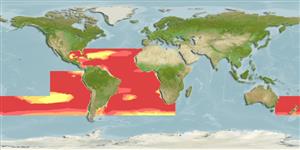
Eastern Atlantic: Spain to Western Sahara. Western Atlantic: Bermuda. Northwest Atlantic: Canada (Ref. 5951). Southwest Pacific: New Zealand (Ref. 5755).
Taille / Poids / Âge
Maturité: Lm ? range ? - ? cm
Max length : 16.0 cm SL mâle / non sexé; (Ref. 4459)
Rayons mous dorsaux (Total) : 13 - 14; Rayons mous anaux: 11 - 12; Vertèbres: 44. Pale, straw-colored ground color. Opercle and snout dusky. Dark pigment distributed on margins of scale pockets (Ref. 37473). Slender body, smoothly narrowed toward the end of caudal peduncle. Maximum depth at the level of the pectoral fin base for 39-69 mm specimens and immediately before the dorsal fin origin for larger ones. Pectoral fins short, not reaching origin of dorsal fin. Operculum without radial grooves. No gill rakers at the inner surface of epibranchial of first gill arch. Swim bladder absent (Ref. 33679).
Body shape (shape guide): elongated.
Usually caught in small aggregations, at 600-900 m in the daytime and 25-500 m at night (Ref. 6345). Feeds on plankton (Ref. 6345).
Cycle de vie et comportement reproducteur
Maturité | Reproduction | Frai | Œufs | Fécondité | Larves
Cohen, D.M., 1990. Bathylagidae. p. 239-240. In J.C. Quero, J.C. Hureau, C. Karrer, A. Post and L. Saldanha (eds.) Check-list of the fishes of the eastern tropical Atlantic (CLOFETA). JNICT, Lisbon; SEI, Paris; and UNESCO, Paris. Vol. 1. (Ref. 4459)
Statut dans la liste rouge de l'IUCN (Ref. 130435: Version 2025-2 (Global))
Menace pour l'homme
Harmless
Utilisations par l'homme
Outils
Articles particuliers
Télécharger en XML
Sources Internet
Estimations basées sur des modèles
Température préférée (Réf.
123201): 8.5 - 17.3, mean 13.1 °C (based on 97 cells).
Indice de diversité phylogénétique (Réf.
82804): PD
50 = 0.5156 [Uniqueness, from 0.5 = low to 2.0 = high].
Bayesian length-weight: a=0.00525 (0.00221 - 0.01248), b=3.01 (2.80 - 3.22), in cm total length, based on LWR estimates for this (Sub)family-body shape (Ref.
93245).
Niveau trophique (Réf.
69278): 3.4 ±0.45 se; based on food items.
Résilience (Réf.
120179): Milieu, temps minimum de doublement de population : 1,4 à 4,4 années (Preliminary K or Fecundity.).
Vulnérabilité de la pêche (Ref.
59153): Low vulnerability (10 of 100).
🛈