Umwelt: Milieu / Klimazone / Tiefenbereich / Verbreitungsgebiet
Ökologie
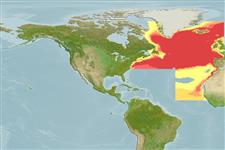
seewasser bathypelagisch; tiefenbereich 0 - 3000 m (Ref. 27000). Deep-water; 73°N - 10°N, 77°W - 1°W
Atlantic Ocean: scattered records from Canada and Greenland to Cape Verde.
Größe / Gewicht / Alter
Geschlechtsreife: Lm ? range ? - ? cm
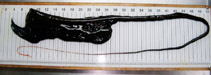
Max length : 161 cm TL Männchen/unbestimmt; (Ref. 27000)
Bathypelagic (Ref. 58426). Feeds on fishes. Oviparous, reduction of jaws and complete loss of teeth in sexually mature specimens of both sexes. Mature males with greatly enlarged olfactory organs (Ref. 6718). Minimum depth from Ref. 58018.
Lebenszyklus und Paarungsverhalten
Geschlechtsreife | Fortpflanzung | Ablaichen | Eier | Fruchtbarkeit | Larven
Nielsen, J.G. and E. Bertelsen, 1990. Saccopharyngidae. p. 204-205. In J.C. Quero, J.C. Hureau, C. Karrer, A. Post and L. Saldanha (eds.) Check-list of the fishes of the eastern tropical Atlantic (CLOFETA). JNICT, Lisbon; SEI, Paris; and UNESCO, Paris. Vol. 1. (Ref. 6539)
IUCN Rote Liste Status (Ref. 130435: Version 2025-2 (Global))
Bedrohung für Menschen
Harmless
Nutzung durch Menschen
Fischereien: nicht kommerziell
Tools
Zusatzinformationen
Download XML
Internet Quellen
Schätzungen auf der Grundlage von Modellen
Bevorzugte Temperatur (Ref.
123201): 2.1 - 11.1, mean 6.1 °C (based on 371 cells).
Phylogenetischer Diversitätsindex (Ref.
82804): PD
50 = 0.5020 [Uniqueness, from 0.5 = low to 2.0 = high].
Bayesian length-weight: a=0.00102 (0.00046 - 0.00225), b=3.06 (2.88 - 3.24), in cm total length, based on all LWR estimates for this body shape (Ref.
93245).
Trophische Ebene (Ref.
69278): 4.5 ±0.80 se; based on food items.
Widerstandsfähigkeit (Ref.
120179): sehr niedrig, Verdopplung der Population dauert mehr als 14 Jahre. (Assuming semelparity and tm>10).
Anfälligkeit der Fischerei (Ref.
59153): Very high vulnerability (90 of 100).
🛈