>
Beryciformes (Sawbellies) >
Stephanoberycidae (Pricklefishes)
Etymology: Acanthochaenus: Greek, akantha = thorn + Greek, chaino = with the mouth opened (Ref. 45335).
Eponymy: Professor Christian Frederik Lütken (1827–1901) was a Danish naturalist, specialising in marine zoology. [...] (Ref. 128868), visit book page.
More on author: Gill.
Environnement : milieu / zone climatique / profondeur / gamme de distribution
Écologie
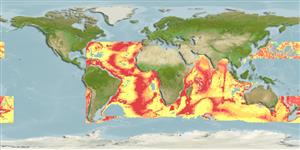
marin benthopélagique; profondeur 1655 - 5397 m (Ref. 58018). Deep-water; 40°N - 57°S, 77°W - 164°W
Atlantic, Indian and Pacific: in subtropical and temperate waters (Ref. 50895). In the Indian Ocean known localities include the Madagascar Ridge (Ref. 51654) and the West Australian Ridge, Naturalist Plateau.
Longueur à la première maturité / Taille / Poids / Âge
Maturité: Lm ?, range 12 - ? cm
Max length : 15.2 cm TL mâle / non sexé; (Ref. 41039)
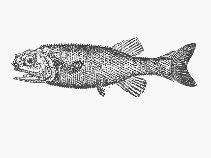
Épines dorsales (Total) : 0; Rayons mous dorsaux (Total) : 11; Épines anales: 1; Rayons mous anaux: 9 - 10. Body scales are spiny (Ref. 37108). Body elongated, almost cylindrical, somewhat compressed (Ref. 10920). The snout protrudes forward above upper jaw, its length 3.4-4.4 times in head length, eyes fairly small, upper jaw extends beyond the posterior border of the eye. Dorsal and anal fins are opposite one another (Ref. 10920).
Body shape (shape guide): fusiform / normal.
Adults probably benthopelagic (Ref. 51654). Larvae taken at 30 m (Ref. 51654). Benthic crabs Malacostraca were found in the stomachs of 3 specimens SL 8.5-9 cm from Madagascar Ridge (Ref. 10920).
Cycle de vie et comportement reproducteur
Maturité | Reproduction | Frai | Œufs | Fécondité | Larves
Maul, G.E., 1990. Stephanoberycidae. p. 611. In J.C. Quero, J.C. Hureau, C. Karrer, A. Post and L. Saldanha (eds.) Check-list of the fishes of the eastern tropical Atlantic (CLOFETA). JNICT, Lisbon; SEI, Paris; and UNESCO, Paris. Vol. 2. (Ref. 6535)
Statut dans la liste rouge de l'IUCN (Ref. 130435: Version 2025-2 (Global))
Menace pour l'homme
Harmless
Utilisations par l'homme
Pêcheries: sans intérêt
Outils
Articles particuliers
Télécharger en XML
Sources Internet
Estimations basées sur des modèles
Température préférée (Réf.
123201): 1.4 - 3.2, mean 2 °C (based on 3882 cells).
Indice de diversité phylogénétique (Réf.
82804): PD
50 = 1.0625 [Uniqueness, from 0.5 = low to 2.0 = high].
Bayesian length-weight: a=0.01122 (0.00514 - 0.02450), b=3.04 (2.87 - 3.21), in cm total length, based on all LWR estimates for this body shape (Ref.
93245).
Niveau trophique (Réf.
69278): 3.5 ±0.60 se; based on food items.
Generation time: 2.7 ( na - na) years. Estimated as median ln(3)/K based on 1
growth studies.
Résilience (Réf.
120179): Milieu, temps minimum de doublement de population : 1,4 à 4,4 années (Assuming tmax > 3; K=0.41).
Vulnérabilité de la pêche (Ref.
59153): Low to moderate vulnerability (29 of 100).
🛈