>
Beryciformes (Sawbellies) >
Cetomimidae (Flabby whalefishes)
Etymology: Cetostoma: Greek, ketos = a marine monster, whale + Greek, stoma = mouth (Ref. 45335).
Eponymy: Charles Tate Regan (1878–1943) was a British ichthyologist. [...] (Ref. 128868), visit book page.
Umwelt: Milieu / Klimazone / Tiefenbereich / Verbreitungsgebiet
Ökologie
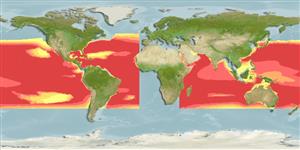
seewasser bathypelagisch; tiefenbereich 0 - 2250 m (Ref. 6715). Deep-water; 50°N - 40°S, 35°E - 13°W
Atlantic Ocean: between 50°N to 40°S; one specimen was recorded at 30°45'N, 25°47'W (Ref. 6715) and 8 specimens from 28°N, 16°E. Indian Ocean: between15°N and 31°S. Pacific Ocean: between 45°N and 15°S, and off central California, USA.
Größe / Gewicht / Alter
Geschlechtsreife: Lm ? range ? - ? cm
Max length : 24.7 cm SL Männchen/unbestimmt; (Ref. 9791)
Rückenflossenstacheln (insgesamt) : 0; Rückenflossenweichstrahlen (insgesamt) : 29 - 37; Afterflossenstacheln: 0; Afterflossenweichstrahlen: 26 - 34; Wirbelzahl: 47 - 53.
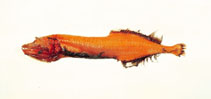
Body shape (shape guide): elongated.
Normal diurnal distribution is between 700 and 1200 m The shallowest diurnal capture (500-600 m) is of one of the smallest specimens (4.3 cm) and the deepest (1500-1600 m) is of one of the largest (20.4 cm), indicating a trend for the diurnal depth to increase with increasing size (Ref. 9791). Nocturnal distribution is between 110-700 m (Ref. 9791). Feeds on decapods and euphausiids (Ref. 6715). Minimum depth from Ref. 58018.
Lebenszyklus und Paarungsverhalten
Geschlechtsreife | Fortpflanzung | Ablaichen | Eier | Fruchtbarkeit | Larven
Paxton, J.R. and D.J. Blake, 1990. Cetomimidae. p. 607-608. In J.C. Quero, J.C. Hureau, C. Karrer, A. Post and L. Saldanha (eds.) Check-list of the fishes of the eastern tropical Atlantic (CLOFETA). JNICT, Lisbon; SEI, Paris; and UNESCO, Parisl. Vol. 2. (Ref. 6532)
IUCN Rote Liste Status (Ref. 130435: Version 2025-2 (Global))
Bedrohung für Menschen
Harmless
Nutzung durch Menschen
Fischereien: bycatch
Tools
Zusatzinformationen
Download XML
Internet Quellen
Schätzungen auf der Grundlage von Modellen
Bevorzugte Temperatur (Ref.
123201): 4.9 - 13.9, mean 8.1 °C (based on 1132 cells).
Phylogenetischer Diversitätsindex (Ref.
82804): PD
50 = 1.0000 [Uniqueness, from 0.5 = low to 2.0 = high].
Bayesian length-weight: a=0.00389 (0.00180 - 0.00842), b=3.12 (2.94 - 3.30), in cm total length, based on all LWR estimates for this body shape (Ref.
93245).
Trophische Ebene (Ref.
69278): 3.4 ±0.45 se; based on food items.
Generation time: 1.6 ( na - na) years. Estimated as median ln(3)/K based on 1
growth studies.
Widerstandsfähigkeit (Ref.
120179): mittel, Verdopplung der Population dauert 1,4 - 4,4 Jahre. (Assuming tmax>3).
Anfälligkeit der Fischerei (Ref.
59153): Low vulnerability (22 of 100).
🛈