>
Beloniformes (Needle fishes) >
Hemiramphidae (Halfbeaks)
Etymology: Hyporhamphus: Greek, hypo = under + Greek, rhamphos = beak, bill (Ref. 45335).
Eponymy: Monsieur Picart is said to have contributed natural history specimens from Cádiz, Spain, to the ‘King’s Cabinet’, but no further elaboration is made. (Ref. 128868), visit book page.
More on author: Valenciennes.
Milieu: milieu / Klimaatzone / Diepte / verspreidingsgebied
Ecologie
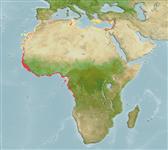
marien; brak water benthopelagisch; diepte 0 - ? m. Subtropical; 37°N - 9°S, 18°W - 36°E
Eastern Atlantic: West to Gibraltar, Morocco and Dakar, Senegal to Luanda, Angola. Eastern Mediterranean: From Lebanon and Israel.
Grootte / Gewicht / Leeftijd
Maturiteit: Lm ? range ? - ? cm
Max length : 20.0 cm TL mannelijk / geslacht onbekend; (Ref. 26999); common length : 15.0 cm TL mannelijk / geslacht onbekend; (Ref. 26999)
Korte beschrijving
Determinatiesleutels | Morfologie | Morfometrie
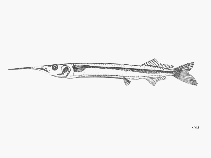
Dorsale stekels (totaal) : 0; Dorsale zachte stralen (totaal) : 13 - 16; Anale stekels: 0; Anale zachte stralen: 13 - 17. Diagnosis: body elongate; lower jaw forming long, narrow beak; upper jaw short, triangular and scaled; scales on snout; well developed preorbital crest between eye and nasal pit; pelvics fin abdominal; dorsal and anal fins placed far back on body and spineless; caudal fin slightly forked (Ref. 57227).
Body shape (shape guide): elongated; Cross section: compressed.
Occurs in coastal waters. Often enters estuaries (Ref. 2683). Live on or near the bottom where it feeds on algae and organic debris which it gathers from the surface of the sediment (Ref. 5377). Forms schools. Attracted to lights at night. Eggs are attached to aquatic vegetation by sticky threads (Ref. 6730).
Levenscyclus en paargedrag
Maturiteit | Voortplanting | Paaien | Eieren | Fecunditeit | Larven
Collette, B.B. and N.V. Parin, 1990. Hemiramphidae. p. 579-582. In J.C. Quero, J.C. Hureau, C. Karrer, A. Post and L. Saldanha (eds.) Check-list of the fishes of the eastern tropical Atlantic (CLOFETA). JNICT, Lisbon; SEI, Paris; and UNESCO, Paris. Vol. 2. (Ref. 4497)
Status op de Rode Lijst van het IUCN (Ref. 130435: Version 2025-2 (Global))
Gevaar voor de mens
Harmless
Gebruik door de mens
Visserij: commercieel
Tools
Speciale rapporten
Download XML
Internetbronnen
Schattingen op basis van modellen
Gewenste temperatuur (Ref.
123201): 18.4 - 27.9, mean 21.9 °C (based on 146 cells).
Fylogenetische diversiteitsindex (Ref.
82804): PD
50 = 0.5000 [Uniqueness, from 0.5 = low to 2.0 = high].
Bayesian length-weight: a=0.00257 (0.00116 - 0.00571), b=3.09 (2.92 - 3.26), in cm total length, based on LWR estimates for this Genus-body shape (Ref.
93245).
Trofisch niveau (Ref.
69278): 2.0 ±0.00 se; based on food items.
Weerstandsvermogen (Ref.
120179): Hoog, minimale populatieverdubbelingstijd minder dan 15 maanden (Preliminary K or Fecundity.).
Kwetsbaarheid van de visserij (Ref.
59153): Low vulnerability (10 of 100).
🛈