sub class Elasmobranchii (ฉลามและกระเบน) (sharks and rays) >
Carcharhiniformes (Ground sharks) >
Carcharhinidae (Requiem sharks)
Etymology: Rhizoprionodon: rhiza (Gr.), root; prion (Gr.) saw; odon (Gr.), tooth, referring to teeth with serrated (saw-like) bases, or roots [replacement name for Rhizoprion Ogilby 1915, preoccupied by Rhizoprion Jourdan 1861 in mammals] (See ETYFish); acutus: Latin for sharp or pointed, probably referring to narrow, pointed snout (See ETYFish).
More on author: Rüppell.
สิ่งแวดล้อม : สิ่งแวดล้อม / เขตภูมิอากาศ / ระดับความลึก / ระยะการกระจายสินค้า
นิเวศวิทยา
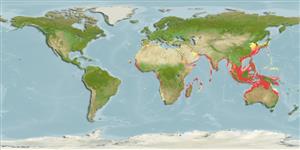
เกี่ยวกับทะเล,น้ำเค็ม; น้ำจืด; กร่อย กลุ่มสัตว์หน้าดิน,กลุ่มสัตว์พื้นท้องน้ำ; สัตว์น้ำที่อพยพไปๆมาๆ ระหว่างแหล่งน้ำจืดกับทะเล ที่เป็นไปตามช่วงชีวิต (Ref. 51243); ระดับความลึก 1 - 200 m (Ref. 244). Tropical; 41°N - 30°S, 27°W - 156°E
Eastern Atlantic: Madeira and Mauritania to Angola (Ref. 244). Indo-West Pacific: Persian Gulf (Ref. 68964), Red Sea and East Africa to Indonesia, north to Japan, south to Australia. Also reported from Gulf of Taranto in Mediterranean Sea (Ref. 231).
ความยาวเมื่อครบกำหนดครั้งแรก / ขนาด / น้ำหนัก / อายุ
วัยเจริญพันธุ์: Lm 75.0, range 70 - 80 cm
Max length : 175 cm TL เพศผู้/กระเทย; (Ref. 12693); 80.8 cm TL (female); common length : 110 cm TL เพศผู้/กระเทย; (Ref. 47737); น้ำหนักสูงสุดที่มีการรายงาน: 5.0 kg (Ref. 132927); อายุสูงสุดที่ได้รายงาน: 8 ปี (Ref. 244)
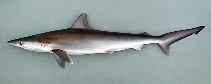
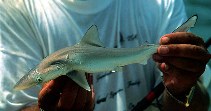
เงี่ยงครีบหลัง (รวม) : 0; เงี่ยงครีบก้น: 0. A small shark with a long, narrow, snout, big eyes without notches, long labial furrows, and oblique-cusped teeth which may be smooth-edged or weakly serrated; 2nd dorsal fin small, low and behind larger anal fin; no interdorsal ridge (Ref. 5578). Grey or grey-brown above, white below (Ref. 5578). Dorsal and anal fins with dusky or blackish edges, fins slightly darker than back (Ref. 9997).
Body shape (shape guide): fusiform / normal.
Found on continental shelves, often on sandy beaches and rarely in estuaries (Ref. 244). Reported to enter freshwater and recorded several times from Cambodia as far upstream as the Great Lake (Ref. 12693). Occurs near the surface in shallow waters (Ref. 12693). Feeds mainly on small pelagic and benthic bony fishes, also cephalopods and other invertebrates (Ref. 244). Viviparous (Ref. 50449). Utilized fresh and possibly dried salted for human consumption and for fishmeal (Ref. 9997). The 178 cm specimen recorded off Africa is possibly based on some other species (Ref. 9997).
Distinct pairing with embrace (Ref. 205). Viviparous, with a yolk-sac placenta; 2 to 8 in a litter (Ref. 9997), usually 2 to 5 after a gestation period of ~ 12 months; no seasonality in the reproductive cycle (Ref.58048). Size at birth between 25 and 39 cm.
Compagno, L.J.V., 1984. FAO Species Catalogue. Vol. 4. Sharks of the world. An annotated and illustrated catalogue of shark species known to date. Part 2 - Carcharhiniformes. FAO Fish. Synop. 125(4/2):251-655. Rome: FAO. (Ref. 244)
สถานะบัญชีแดงของ IUCN (Ref. 130435: Version 2025-2 (Global))
การใช้ของมนุษย์
การประมง: การค้า; การตกปลาเป็นกีฬา: ใช่
เครื่องมือ
รายงานพิเศษ
ดาวน์โหลด XML
แหล่งที่มาจากอินเตอร์เน็ต
การประมาณค่าตามแบบจำลอง
อุณหภูมิที่ต้องการ (อ้างอิง
123201): 19.6 - 28.5, mean 26.9 °C (based on 1463 cells).
ดัชนีความหลากหลายทางวิวัฒนาการ (อ้างอิง
82804): PD
50 = 0.5078 [Uniqueness, from 0.5 = low to 2.0 = high].
Bayesian length-weight: a=0.00347 (0.00279 - 0.00431), b=3.06 (3.02 - 3.10), in cm total length, based on LWR estimates for this species (Ref.
93245).
ระดับชั้นอาหาร (อ้างอิง
69278): 4.3 ±0.4 se; based on diet studies.
Generation time: 5.5 ( na - na) years. Estimated as median ln(3)/K based on 1
growth studies.
ความสามารถในการกลับคืนสู่ปกติ (อ้างอิง
120179): ต่ำมาก, เวลาต่ำสุดที่จะทำให้ประชากรเพิ่มขึ้นเป็น 2 เท่าใช้เวลามากกว่า 14 ปี (K=0.2-0.6; Fec=1).
ความเสี่ยงต่อการตกปลา (Ref.
59153): High vulnerability (61 of 100).
🛈
สารอาหาร (Ref.
124155): Calcium = 16.4 [2.3, 90.2] mg/100g; Iron = 0.575 [0.146, 1.652] mg/100g; Protein = 21.2 [18.2, 23.5] %; Omega3 = 0.198 [0.082, 0.472] g/100g; Selenium = 58 [16, 171] μg/100g; VitaminA = 20.7 [7.9, 53.8] μg/100g; Zinc = 0.698 [0.324, 1.318] mg/100g (wet weight);