Lớp phụ Cá sụn (cá mập và cá đuối) (sharks and rays) >
Carcharhiniformes (Ground sharks) >
Carcharhinidae (Requiem sharks)
Etymology: Negaprion: negatus (L.), to deny; prion (Gr.), saw, referring to lack of saw-like serrations on teeth cusps (See ETYFish); acutidens: acutus (L.), sharp or pointed; dens, from dentis (L.), tooth, probably referring to pyramid-like teeth (“dünnen spitzen Pyramiden”) (See ETYFish).
More on author: Rüppell.
Môi trường: môi trường / vùng khí hậu / Mức độ sâu / phạm vi phân phối
Sinh thái học
biển; thuộc về nước lợ cùng sống ở rạn san hô; oceano-estuarine (Ref. 129182); mức độ sâu 0 - 92 m (Ref. 244). Tropical; 30°N - 32°S, 32°E - 140°W (Ref. 244)
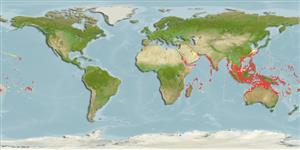
Indo-Pacific: Red Sea and South Africa (including Mauritius, Seychelles, Madagascar) to Philippines, north to Viet Nam, south to Australia. Also from Palau, Marshall Islands, and Tahiti. Recorded from Taiwan (Ref. 4868).
Chiều dài lúc trưởng thành đầu tiên / Bộ gần gũi / Khối lượng (Trọng lượng) / Tuổi
Chín muồi sinh dục: Lm 230.0, range 220 - 240 cm
Max length : 380 cm TL con đực/không giới tính; (Ref. 5213)
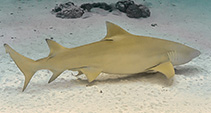
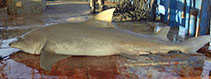
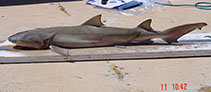
Các tia vây lưng cứng (tổng cộng) : 0; Tia cứng vây hậu môn: 0. A large, stocky, yellowish shark with a broad, blunt snout, narrow, smooth-cusped teeth in both jaws, and equal-sized dorsal fins (Ref. 5578). Yellowish brown above, paler below (Ref. 9997). With two nearly equally large dorsal fins (Ref. 37816).
Body shape (shape guide): fusiform / normal.
Adults are found on continental and insular shelves and terraces (Ref. 244). And are common on coral reefs (Ref. 5578). Juveniles are confined to shallow inshore areas, with preference for sandy lagoons and turbid, mangrove swamps (Refs. 6871, 129182). Adults feed on smaller sharks, stingrays and on benthic bony fishes (Ref. 5578). Viviparous (Ref. 50449). Dangerous if provoked (Ref. 244). 1 to 11 of 45 cm young are born per litter (Ref. 1602). Meat is utilized fresh and dried salted for human consumption, fins for shark-fin soup base, and liver oil for vitamins (Ref. 244).
Viviparous, placental (Ref. 50449), 1-14 per litter (Ref. 6871). Gestation period 10-11 months (Ref. 5578; Ref.58048). Size at birth about 50 to 70 cm TL (Ref. 9997); 45-80 cm TL (Ref.58048). Distinct pairing with embrace (Ref. 205). Mating and pupping take place during late spring and early summer (Ref. 37816).
Compagno, L.J.V., 1984. FAO Species Catalogue. Vol. 4. Sharks of the world. An annotated and illustrated catalogue of shark species known to date. Part 2 - Carcharhiniformes. FAO Fish. Synop. 125(4/2):251-655. Rome: FAO. (Ref. 244)
Tình trạng Sách đỏ IUCN (Ref. 130435: Version 2025-2 (Global))
Mối đe dọa đối với con người
Sử dụng của con người
Các nghề cá: tính thương mại
Các công cụ
Báo cáo đặc biệt
Tải xuống XML
Các nguồn internet
Ước tính dựa trên mô hình
Nhiệt độ ưa thích (Tài liệu tham khảo
123201): 24.7 - 29.1, mean 28.1 °C (based on 2034 cells).
Chỉ số đa dạng phát sinh loài (Tài liệu tham khảo
82804): PD
50 = 0.7500 [Uniqueness, from 0.5 = low to 2.0 = high].
Bayesian length-weight: a=0.00490 (0.00233 - 0.01031), b=3.08 (2.91 - 3.25), in cm total length, based on LWR estimates for this (Sub)family-body shape (Ref.
93245).
Mức dinh dưỡng (Tài liệu tham khảo
69278): 4.1 ±0.6 se; based on diet studies.
Thích nghi nhanh (Tài liệu tham khảo
120179): Rất thấp, thời gian nhân đôi của chủng quần tối thiểu là hơn 14 năm (Fec=1).
Sự dễ bị tổn thương của nghề đánh cá (Ref.
59153): Very high vulnerability (90 of 100).
🛈
Chất dinh dưỡng (Ref.
124155): Calcium = 4.33 [0.92, 24.01] mg/100g; Iron = 0.333 [0.079, 0.955] mg/100g; Protein = 21.8 [19.4, 24.0] %; Omega3 = 0.0965 [, ] g/100g; Selenium = 36.1 [10.5, 103.9] μg/100g; VitaminA = 35.2 [11.3, 117.2] μg/100g; Zinc = 0.6 [0.3, 1.2] mg/100g (wet weight);