>
Ophidiiformes (Cusk eels) >
Ophidiidae (Cusk-eels) > Neobythitinae
Etymology: Bassozetus: Latin, bassus = thick, fat + Greek, ketos = marine mosnter, whale (Ref. 45335).
More on author: Vaillant.
Umwelt: Milieu / Klimazone / Tiefenbereich / Verbreitungsgebiet
Ökologie
seewasser bathydemersal; tiefenbereich ? - 3200 m (Ref. 34024). Deep-water
Eastern Central Atlantic: known only from a single specimen caught off Cape Verde.
Größe / Gewicht / Alter
Geschlechtsreife: Lm ? range ? - ? cm
Max length : 22.1 cm SL Männchen/unbestimmt; (Ref. 3686)
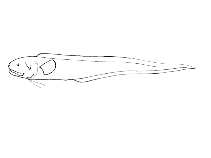
Snout inflated; eyes much smaller than snout; opercular spine weak or absent; preopercle without spines and posteriorly expanded almost reaching posterior margin of opercle; pseudobranchial filaments 2 (Ref. 34024).
Rare species (Ref. 34024). Oviparous, with oval pelagic eggs floating in a gelatinous mass (Ref. 205).
Lebenszyklus und Paarungsverhalten
Geschlechtsreife | Fortpflanzung | Ablaichen | Eier | Fruchtbarkeit | Larven
Nielsen, J.G., 1990. Ophidiidae. p. 564-573. In J.C. Quero, J.C. Hureau, C. Karrer, A. Post and L. Saldanha (eds.) Check-list of the fishes of the eastern tropical Atlantic (CLOFETA). JNICT, Lisbon; SEI, Paris; and UNESCO, Paris. Vol. 2. (Ref. 3686)
IUCN Rote Liste Status (Ref. 130435: Version 2025-2 (Global))
Bedrohung für Menschen
Harmless
Nutzung durch Menschen
Fischereien: nicht kommerziell
Tools
Zusatzinformationen
Download XML
Internet Quellen
Schätzungen auf der Grundlage von Modellen
Phylogenetischer Diversitätsindex (Ref.
82804): PD
50 = 0.5000 [Uniqueness, from 0.5 = low to 2.0 = high].
Bayesian length-weight: a=0.00110 (0.00040 - 0.00299), b=3.08 (2.84 - 3.32), in cm total length, based on LWR estimates for this (Sub)family-body shape (Ref.
93245).
Trophische Ebene (Ref.
69278): 3.5 ±0.6 se; based on size and trophs of closest relatives
Widerstandsfähigkeit (Ref.
120179): mittel, Verdopplung der Population dauert 1,4 - 4,4 Jahre. (Assuming tmax>3).
Anfälligkeit der Fischerei (Ref.
59153): Low vulnerability (17 of 100).
🛈