>
Ophidiiformes (Cusk eels) >
Ophidiidae (Cusk-eels) > Neobythitinae
Etymology: Acanthonus: Greek, akantha = thorn + Greek, onos = hake.
More on author: Günther.
Ambiente: milieu / zona climatica / distribuzione batimetrica / gamma di distribuzione
Ecologia
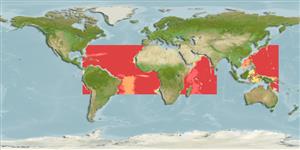
marino batipelagico; distribuzione batimetrica 1171 - 4415 m (Ref. 75877). Deep-water; 36°N - 23°S, 81°W - 154°E
In deep waters off tropical and subtropical areas of all oceans. Especially abundant in the tropical western Atlantic (Ref. 3686). Reported from Carlsberg Ridge (6°22'N 60°12'E) and New Guinea (Ref. 33390). Known from Gulf of Mexico, Caribbean Sea, southern India, Philippines, Gulf of Panama and tropical west Africa (Ref. 44076).
Dimensione / Peso / Età
Maturità: Lm ? range ? - ? cm
Max length : 37.5 cm SL maschio/sesso non determinato; (Ref. 34024)
Breve descrizione
Chiavi di identificazione | Morfologia | Morfometria
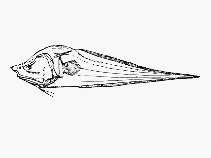
Head large and body tapering. Snout with prominent, bifid spine. Opercular spine long and slender extending well beyond rear margin of head. Well developed spines at lower angle of preopercle. Eye small. Anterior gill arch with 16-22 developed rakers. Precaudal vertebrae 9-10.
Benthopelagic at bathyal and abyssal depths (Ref. 56809). Common species (Ref. 34024). Oviparous, with oval pelagic eggs floating in a gelatinous mass (Ref. 205). Noted as having the smallest relative brain size among teleosts, and remarkably large semicircular canals (Ref. 7463).
Ciclo vitale e comportamento di accoppiamento
Maturità | Riproduzione | Deposizione | Uova | Fecondità | Larve
Nielsen, J.G., 1990. Ophidiidae. p. 564-573. In J.C. Quero, J.C. Hureau, C. Karrer, A. Post and L. Saldanha (eds.) Check-list of the fishes of the eastern tropical Atlantic (CLOFETA). JNICT, Lisbon; SEI, Paris; and UNESCO, Paris. Vol. 2. (Ref. 3686)
Stato della Lista Rossa IUCN (Ref. 130435: Version 2025-2 (Global))
Minaccia per l'uomo
Harmless
Usi umani
Pesca: di nessun interesse
Strumenti
Rapporti speciali
Scarica XML
Fonti Internet
Stime basate su modelli
Temperatura preferita (Fonte Biblio.
123201): 1.8 - 4.1, mean 2.7 °C (based on 1440 cells).
Indice di diversità filogenetica (Fonte Biblio.
82804): PD
50 = 1.0000 [Uniqueness, from 0.5 = low to 2.0 = high].
Bayesian length-weight: a=0.00110 (0.00040 - 0.00299), b=3.08 (2.84 - 3.32), in cm total length, based on LWR estimates for this (Sub)family-body shape (Ref.
93245).
Livello trofico (Fonte Biblio.
69278): 3.6 ±0.6 se; based on size and trophs of closest relatives
Resilienza (Fonte Biblio.
120179): Medio, tempo minimo di raddoppiamento della popolazione 1.4 - 4.4 anni (Preliminary K or Fecundity.).
Vulnerabilità della pesca (Ref.
59153): Moderate vulnerability (36 of 100).
🛈