>
Cichliformes (Cichlids, convict blennies) >
Cichlidae (Cichlids) > Pseudocrenilabrinae
Eponymy: François-Romain Thollon (1855–1896) was a French botanist and collector who resigned (1882) from MNHN Paris to work in the Congo and as a member of the de Brazza mission in Gabon. [...] (Ref. 128868), visit book page.
More on author: Sauvage.
Environnement : milieu / zone climatique / profondeur / gamme de distribution
Écologie
; eau douce benthopélagique. Tropical; 24°C - 26°C (Ref. 12468)
Africa: from the Ogooué River in Gabon (Ref. 81260) to the lower Congo River in Democratic Republic of the Congo (Ref. 55074, 74387, 120641), including the Nyanza in Gabon, Kouilou-Niari in Republic of Congo, and the Chiloango in Angola and Democratic Republic of the Congo (Ref. 81260). Specimens from Pool Malebo are either this species or C. congica (Ref. 55074, 74387).
Taille / Poids / Âge
Maturité: Lm ? range ? - ? cm
Max length : 22.0 cm TL mâle / non sexé; (Ref. 5163)
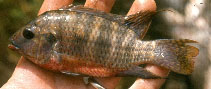
Épines dorsales (Total) : 15 - 16; Rayons mous dorsaux (Total) : 9 - 11; Épines anales: 3; Rayons mous anaux: 7 - 9. Diagnosis: 10 or fewer rakers on lower limb of first arch; unpaired fins not predominantly red-brown; mouth terminal; caudal fin densely covered with scales and with network of clear spots and lines; at least 1 row (sometimes 2) of dark spots in the middle of the body; a black sickle-shaped spot at the base of each flank scale; dorsal fin with 15-16 spines and 9-11 soft rays (total rays 24-26); anal fin with 3 spines and 7-9 soft rays; 27-29 scales in lateral line; outer row teeth relatively fine (Ref. 81260).
Body shape (shape guide): fusiform / normal.
Pair-bonding, open (Ref. 52307) substrate brooder (Ref. 52307, 81260) with both parents guarding the brood (Ref. 52307).
Cycle de vie et comportement reproducteur
Maturité | Reproduction | Frai | Œufs | Fécondité | Larves
Dunz, A.R. and U.K. Schliewen, 2013. Molecular phylogeny and revised classification of the haplotilapiine cichlid fishes formerly referred to as "Tilapia". Mol. Phylogenet. Evol. 68(1):64-80. (Ref. 93285)
Statut dans la liste rouge de l'IUCN (Ref. 130435: Version 2025-2 (Global))
Menace pour l'homme
Harmless
Utilisations par l'homme
Outils
Articles particuliers
Télécharger en XML
Sources Internet
Estimations basées sur des modèles
Indice de diversité phylogénétique (Réf.
82804): PD
50 = 0.5000 [Uniqueness, from 0.5 = low to 2.0 = high].
Bayesian length-weight: a=0.01445 (0.00671 - 0.03113), b=2.99 (2.82 - 3.16), in cm total length, based on LWR estimates for this (Sub)family-body shape (Ref.
93245).
Niveau trophique (Réf.
69278): 2.6 ±0.1 se; based on size and trophs of closest relatives
Résilience (Réf.
120179): Haut, temps minimum de doublement de population inférieur à 15 mois (Preliminary K or Fecundity.).
Vulnérabilité de la pêche (Ref.
59153): Low vulnerability (12 of 100).
🛈