Elasmobranquios (tiburones y rayas) (sharks and rays) >
Rajiformes (Skates and rays) >
Rajidae (Skates)
Etymology: Raja: Latin, raja, -ae = a sting ray (Raja sp.) (Ref. 45335).
Entorno: milieu / zona climática / rango de profundidad / gama de distribución
Ecología
marino demersal; rango de profundidad ? - 300 m (Ref. 4426). Subtropical; 46°N - 30°N, 8°W - 36°E
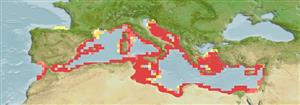
Eastern Atlantic: known only from the Mediterranean but may penetrate through the Strait of Gibraltar and possibly to northern Morocco. Some Atlantic records probably misidentifications of Raja naevus and/or Raja africana.
Tamaño / Peso / Edad
Madurez: Lm ? range ? - ? cm
Max length : 70.0 cm TL macho / no sexado; (Ref. 4426)
Range from coastal waters to about 300 m depth (Ref. 3167). Feed on all kinds of bottom animals (Ref. 3167). Oviparous. Distinct pairing with embrace. Young may tend to follow large objects, such as their mother (Ref. 205). Eggs are oblong capsules with stiff pointed horns at the corners deposited in sandy or muddy flats (Ref. 205). About 80-154 eggs are laid by an individual in a year (Ref. 41305).
Ciclo vital y comportamiento de apareamiento
Madurez | Reproducción | Puesta | Huevos | Fecundidad | Larva
Oviparous, paired eggs are laid. Embryos feed solely on yolk (Ref. 50449). Spawns throughout the year with maximum number of egg-cases laid in late spring and summer, embryos developing in about 4 months (Ref. 3167). Distinct pairing with embrace. Young may tend to follow large objects, such as their mother (Ref. 205).
McEachran, J.D. and K.A. Dunn, 1998. Phylogenetic analysis of skates, a morphologically conservative clade of elasmobranchs (Chondrichthyes: Rajidae). Copeia 1998(2):271-290. (Ref. 27314)
Situación en la Lista Roja de la UICN (Ref. 130435: Version 2025-2 (Global))
Amenaza para el ser humano
Harmless
Usos humanos
Pesquerías: comercial
Herramientas
Informes especiales
Descargar XML
Fuentes de Internet
Estimaciones basadas en modelos
Temperatura preferida (Referencia
123201): 13.4 - 18.4, mean 15 °C (based on 128 cells).
Índice de diversidad filogenética (Referencia
82804): PD
50 = 0.5000 [Uniqueness, from 0.5 = low to 2.0 = high].
Bayesian length-weight: a=0.00339 (0.00214 - 0.00537), b=3.19 (3.06 - 3.32), in cm total length, based on LWR estimates for this species & Genus-body shape (Ref.
93245).
Nivel trófico (Referencia
69278): 3.7 ±0.54 se; based on food items.
Resiliencia (Referencia
120179): Bajo, población duplicada en un tiempo mínimo de 4.5-14 años (Fec=80).
Vulnerabilidad pesquera (Ref.
59153): Moderate to high vulnerability (48 of 100).
🛈
Nutrientes (Ref.
124155): Calcium = 27.4 [5.4, 126.2] mg/100g; Iron = 0.815 [0.213, 2.369] mg/100g; Protein = 18.6 [15.3, 21.6] %; Omega3 = 0.723 [0.220, 2.585] g/100g; Selenium = 24.6 [7.1, 73.7] μg/100g; VitaminA = 9.78 [3.77, 24.88] μg/100g; Zinc = 0.587 [0.285, 1.067] mg/100g (wet weight);