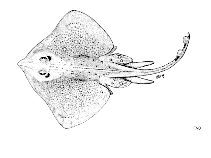
Elasmobranchii (Haie und Rochen) (sharks and rays) >
Rajiformes (Skates and rays) >
Rajidae (Skates)
Etymology: Raja: Latin, raja, -ae = a sting ray (Raja sp.) (Ref. 45335).
Umwelt: Milieu / Klimazone / Tiefenbereich / Verbreitungsgebiet
Ökologie
seewasser demersal; tiefenbereich 0 - 700 m (Ref. 127922), usually 20 - 50 m (Ref. 117283). Subtropical; 46°N - 30°N, 10°W - 36°E
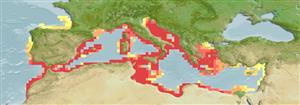
Eastern Atlantic: endemic to the Mediterranean but may spread to the Strait of Gibraltar, northern Morocco and possibly south to Mauritania.
Größe / Gewicht / Alter
Geschlechtsreife: Lm ? range ? - ? cm
Max length : 75.0 cm TL Männchen/unbestimmt; (Ref. 100834); max. veröff. Gewicht: 2.5 kg (Ref. 100834)
Inhabit inshore waters (Ref. 3167). Depth range to 170 m (Ref. 04426), and from 333-343 m in the eastern Ionian Sea (Ref. 56504). Feed on all kinds of benthic animals (Ref. 3167). Oviparous. Distinct pairing with embrace. Young may tend to follow large objects, such as their mother (Ref. 205). Eggs are oblong capsules with stiff pointed horns at the corners deposited in sandy or muddy flats (Ref. 205). Egg capsules are 4.5 cm long and 3.0 cm wide (Ref. 41304). Minimum depth range (Ref. 114953).
Lebenszyklus und Paarungsverhalten
Geschlechtsreife | Fortpflanzung | Ablaichen | Eier | Fruchtbarkeit | Larven
Oviparous, paired eggs are laid. Embryos feed solely on yolk (Ref. 50449). Spawning peak in summer to early autumn with 30 to more than 100 egg-cases per year depending on the size of the female (Ref. 3167). Distinct pairing with embrace. Young may tend to follow large objects, such as their mother (Ref. 205).
McEachran, J.D. and K.A. Dunn, 1998. Phylogenetic analysis of skates, a morphologically conservative clade of elasmobranchs (Chondrichthyes: Rajidae). Copeia 1998(2):271-290. (Ref. 27314)
IUCN Rote Liste Status (Ref. 130435: Version 2025-2 (Global))
Bedrohung für Menschen
Harmless
Nutzung durch Menschen
Fischereien: weniger kommerziell
Tools
Zusatzinformationen
Download XML
Internet Quellen
Schätzungen auf der Grundlage von Modellen
Bevorzugte Temperatur (Ref.
123201): 13.3 - 15.7, mean 14.3 °C (based on 100 cells).
Phylogenetischer Diversitätsindex (Ref.
82804): PD
50 = 0.5000 [Uniqueness, from 0.5 = low to 2.0 = high].
Bayesian length-weight: a=0.00263 (0.00217 - 0.00319), b=3.24 (3.20 - 3.28), in cm total length, based on LWR estimates for this species (Ref.
93245).
Trophische Ebene (Ref.
69278): 3.8 ±0.6 se; based on diet studies.
Generation time: 2.4 ( na - na) years. Estimated as median ln(3)/K based on 1
growth studies.
Widerstandsfähigkeit (Ref.
120179): niedrig, Verdopplung der Population dauert 4,5 - 14 Jahre. (Fec assumed to be <100).
Anfälligkeit der Fischerei (Ref.
59153): Low to moderate vulnerability (33 of 100).
🛈
Klimaanfälligkeit (Ref.
125649): Moderate to high vulnerability (55 of 100).
🛈
Nährstoffe (Ref.
124155): Calcium = 17 [2, 314] mg/100g; Iron = 0.821 [0.076, 9.969] mg/100g; Protein = 17.5 [14.6, 19.8] %; Omega3 = 0.602 [0.272, 1.402] g/100g; Selenium = 29.3 [5.7, 156.6] μg/100g; VitaminA = 4.39 [0.37, 47.95] μg/100g; Zinc = 0.472 [0.029, 5.467] mg/100g (wet weight);