Elasmobranchii (haaien en roggen) (sharks and rays) >
Carcharhiniformes (Ground sharks) >
Carcharhinidae (Requiem sharks)
Etymology: Lamiopsis: Etymology not explained nor evident, perhaps Gill thought L. temminckii resembled (-opsis, Greek for appearance) members of the family Lamnidae (Lamia = Lamna) (See ETYFish); temminckii: In honor of Coenraad Jacob Temminck (1778-1858), director of the Rijksmuseum van Natuurlijke Historie (Leiden, Netherlands), who “unlocked the treasures” (translation) of the museum during the authors’ visit in 1837 (See ETYFish).
Eponymy: Coenraad Jacob Temminck (1778–1858) was a Dutch zoologist, illustrator and collector. [...] (Ref. 128868), visit book page.
More on authors: Müller & Henle.
Milieu: milieu / Klimaatzone / Diepte / verspreidingsgebied
Ecologie
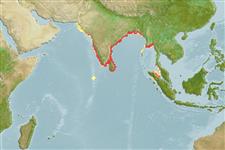
marien; brak water demersaal; amfidroom (Ref. 51243); diepte ? - 50 m. Tropical; 26°N - 2°N, 65°E - 100°E
Indian Ocean: records validated from India and Bangladesh. IUCN assessment needs to be revised for L. temminckii since L. tephrodes was resurrected from its synonymy (Ref. 84282).
Lengte bij maturiteit / Grootte / Gewicht / Leeftijd
Maturiteit: Lm ?, range 130 - ? cm
Max length : 160 cm TL mannelijk / geslacht onbekend; (Ref. 121648); 208.0 cm TL (female); max. gepubliceerd gewicht: 52.4 kg (Ref. 121648); max. gepubliceerd gewicht: 52.4 kg
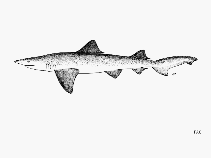
Dorsale stekels (totaal) : 0; Anale stekels: 0. Grey or yellow-grey above, lighter below; no conspicuous markings (Ref. 9997).
Body shape (shape guide): fusiform / normal.
A little-known shark found in coastal, inshore waters (Ref. 244). Probably feeds on small fishes and invertebrates (Ref. 9997). Viviparous (Ref. 50449). Not known to be dangerous to people (Ref. 244). Meat utilized fresh and dried salted for human consumption, liver for oil (Ref.244). Caught irregularly by inshore gillnet fisheries, particularly those operating off Borneo (Ref.58048).
Viviparous, placental (Ref. 50449), with 4 to 8 young per litter (Ref. 244). Gestation period of ~ 8 months (Ref.58048). Size at birth between 40 and 60 cm (Ref. 244). Distinct pairing with embrace (Ref. 205).
Compagno, L.J.V., 1984. FAO Species Catalogue. Vol. 4. Sharks of the world. An annotated and illustrated catalogue of shark species known to date. Part 2 - Carcharhiniformes. FAO Fish. Synop. 125(4/2):251-655. Rome: FAO. (Ref. 244)
Status op de Rode Lijst van het IUCN (Ref. 130435: Version 2025-2 (Global))
Gebruik door de mens
Visserij: commercieel
Tools
Speciale rapporten
Download XML
Internetbronnen
Schattingen op basis van modellen
Gewenste temperatuur (Ref.
123201): 26.8 - 29.3, mean 28.4 °C (based on 172 cells).
Fylogenetische diversiteitsindex (Ref.
82804): PD
50 = 0.7500 [Uniqueness, from 0.5 = low to 2.0 = high].
Bayesian length-weight: a=0.00479 (0.00305 - 0.00752), b=3.07 (2.94 - 3.20), in cm total length, based on LWR estimates for this species & (Sub)family-body (Ref.
93245).
Trofisch niveau (Ref.
69278): 4.0 ±0.61 se; based on food items.
Weerstandsvermogen (Ref.
120179): Zeer laag, minimale populatieverdubbelingstijd meer dan 14 jaar (Fec=4).
Kwetsbaarheid van de visserij (Ref.
59153): Very high vulnerability (90 of 100).
🛈