Klassifizierung / Names
Namen | Synonyme | Catalog of Fishes(Gattung, Arten) | ITIS | CoL | WoRMS | Cloffa
>
Pleuronectiformes (Flatfishes) >
Soleidae (Soles)
Etymology: Aseraggodes: Greek, aggos, -eos, -ous = vessel, uterus, carapace of a crab + Greek, aseros, -a, -on = to remove the appetite (Ref. 45335).
Umwelt: Milieu / Klimazone / Tiefenbereich / Verbreitungsgebiet
Ökologie
seewasser demersal; tiefenbereich 6 - 10 m (Ref. 56490). Temperate
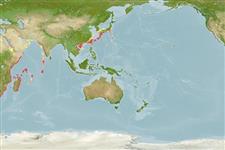
Indo-West Pacific: Sodwana Bay (South Africa), Porto Amelia (Mozambique) and Japan.
Größe / Gewicht / Alter
Geschlechtsreife: Lm ? range ? - ? cm
Max length : 8.0 cm TL Männchen/unbestimmt; (Ref. 3200)
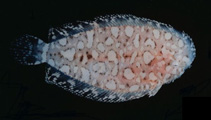
Rückenflossenstacheln (insgesamt) : 0; Rückenflossenweichstrahlen (insgesamt) : 64 - 67; Afterflossenstacheln: 0; Afterflossenweichstrahlen: 42 - 44; Wirbelzahl: 33 - 34. Diagnosis: Dorsal rays 64-67; anal rays 42-44; dorsal and anal rays are not branched. Caudal rays 18, the middle 14 branched. Lateral-line scales of ocular side 64-67; the line extending forward nearly to upper eye, with a ventral branch on head following the edge of the preopercle. Vertebrae 10 + 23-24. Dorsal pterygiophores anterior to fourth neural spine 14-15. Body depth 2.4-2.5 in SL; head length 3.55-3.65 in SL; snout long, 2.6-2.95 in head length; interorbital space narrow, 13.7-20.8 in head length. Caudal peduncle very short, 19.5-23.2 in HL. Tubular anterior nostril anterior to upper edge of lower eye, just reaching cutaneous edge of lower orbit when depressed posteriorly. Two rows of scales in interorbital space, none extending onto medial edges of eyes. Anterior edge of snout of largest specimen (23 mm SL) with a series of 12 conspicuous lappet-like cirri. Ventral margin of head with 20 similar cirri, the longest on chin about equal to pupil diameter; no cirri on opercular edge of either side of gill opening. Jaws of blind side surrounded by a zone of small papillae. Dorsal and anal rays long, the longest dorsal ray 2.5-3.0 in HL. No sheath of scales over base of dorsal and anal fins, at most one row of scales over basal part of rays. Rounded caudal fin and moderately long, 3.2-3.45 in SL. Pelvic fins long, reaching base of third or fourth anal ray, 1.65-1.9 in HL. Color of ocular side when fresh light gray with large irregular dark-edged white spots on head and body, scattered small whitish spots, fewer small black spots, a black spot the size of eye on lateral line in middle of body and a double black spot on lateral line in middle of posterior half of body (Ref. 56490).
Body shape (shape guide): short and / or deep; Cross section: compressed.
Inhabits sand bottoms including reef flats and tide pools in 0-10 m (Ref. 90102).
Lebenszyklus und Paarungsverhalten
Geschlechtsreife | Fortpflanzung | Ablaichen | Eier | Fruchtbarkeit | Larven
Heemstra, P.C. and O. Gon, 1986. Soleidae. p. 868-874. In M.M. Smith and P.C. Heemstra (eds.) Smiths' sea fishes. Springer-Verlag, Berlin. (Ref. 3200)
IUCN Rote Liste Status (Ref. 130435: Version 2025-2 (Global))
Bedrohung für Menschen
Harmless
Nutzung durch Menschen
Tools
Zusatzinformationen
Download XML
Internet Quellen
Schätzungen auf der Grundlage von Modellen
Bevorzugte Temperatur (Ref.
123201): 23.5 - 28.9, mean 27 °C (based on 509 cells).
Phylogenetischer Diversitätsindex (Ref.
82804): PD
50 = 0.5000 [Uniqueness, from 0.5 = low to 2.0 = high].
Bayesian length-weight: a=0.00955 (0.00454 - 0.02011), b=3.07 (2.90 - 3.24), in cm total length, based on LWR estimates for this (Sub)family-body shape (Ref.
93245).
Trophische Ebene (Ref.
69278): 3.4 ±0.5 se; based on size and trophs of closest relatives
Widerstandsfähigkeit (Ref.
120179): hoch, Verdopplung der Population dauert weniger als 15 Monate. (Preliminary K or Fecundity.).
Anfälligkeit der Fischerei (Ref.
59153): Low vulnerability (10 of 100).
🛈