Elasmobranchii (Haie und Rochen) (sharks and rays) >
Rajiformes (Skates and rays) >
Rajidae (Skates)
Etymology: Dipturus: Greek, di = two + Greek, pteryx = fin (Ref. 45335).
Umwelt: Milieu / Klimazone / Tiefenbereich / Verbreitungsgebiet
Ökologie
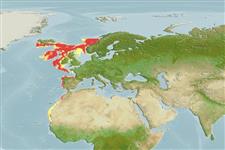
seewasser bathydemersal; tiefenbereich 125 - 1420 m (Ref. 114953). Deep-water; 67°N - 16°N, 25°W - 14°E
Eastern Atlantic: fjords of central and southern Norway, southern Iceland, around Rockall Trough in Ireland and northern Mauritania (Ref. 4426); Western and central Mediterreneann Sea (Ref. 125963).
Größe / Gewicht / Alter
Geschlechtsreife: Lm ? range ? - ? cm
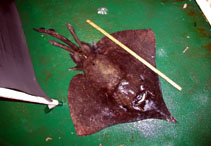
Max length : 200 cm TL Männchen/unbestimmt; (Ref. 4426)
Inhabit deep slope waters (Ref. 3167), probably most common on the mid-slope (Ref. 114953). Feed on all kinds of bottom animals (Ref. 3167), mainly invertebrates and small fishes (Ref. 114953). Size possibly up to 250 cm TL (Ref. 114953). Oviparous. Distinct pairing with embrace. Young may tend to follow large objects, such as their mother (Ref. 205). Eggs are oblong capsules with stiff pointed horns at the corners deposited in sandy or muddy flats (Ref. 205). Egg capsules are 18.2-26.0 cm long and 9.2-11.3 cm wide (Ref. 41251, 41309). Sizes of maturity and hatching unknown (Ref. 114953).
Lebenszyklus und Paarungsverhalten
Geschlechtsreife | Fortpflanzung | Ablaichen | Eier | Fruchtbarkeit | Larven
Oviparous, paired eggs are laid. Embryos feed solely on yolk (Ref. 50449). Distinct pairing with embrace. Young may tend to follow large objects, such as their mother (Ref. 205).
McEachran, J.D. and K.A. Dunn, 1998. Phylogenetic analysis of skates, a morphologically conservative clade of elasmobranchs (Chondrichthyes: Rajidae). Copeia 1998(2):271-290. (Ref. 27314)
IUCN Rote Liste Status (Ref. 130435: Version 2025-2 (Global))
Bedrohung für Menschen
Harmless
Nutzung durch Menschen
Fischereien: nicht kommerziell
Tools
Zusatzinformationen
Download XML
Internet Quellen
Schätzungen auf der Grundlage von Modellen
Bevorzugte Temperatur (Ref.
123201): 2.1 - 10.8, mean 7.1 °C (based on 138 cells).
Phylogenetischer Diversitätsindex (Ref.
82804): PD
50 = 0.5000 [Uniqueness, from 0.5 = low to 2.0 = high].
Bayesian length-weight: a=0.00288 (0.00136 - 0.00613), b=3.25 (3.08 - 3.42), in cm total length, based on LWR estimates for this Genus-body shape (Ref.
93245).
Trophische Ebene (Ref.
69278): 3.5 ±0.37 se; based on food items.
Widerstandsfähigkeit (Ref.
120179): niedrig, Verdopplung der Population dauert 4,5 - 14 Jahre. (Fec assumed to be <100).
Anfälligkeit der Fischerei (Ref.
59153): Very high vulnerability (90 of 100).
🛈
Nährstoffe (Ref.
124155): Calcium = 2.52 [0.35, 50.19] mg/100g; Iron = 0.251 [0.024, 3.283] mg/100g; Protein = 15.3 [13.2, 17.3] %; Omega3 = 0.371 [0.154, 0.920] g/100g; Selenium = 23.3 [4.1, 104.2] μg/100g; VitaminA = 2.81 [0.20, 39.61] μg/100g; Zinc = 0.241 [0.016, 2.910] mg/100g (wet weight);