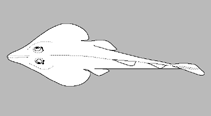
Elasmobranchi (squali e razze) (sharks and rays) >
Rhinopristiformes (Shovelnose rays) >
Rhinobatidae (Guitarfishes)
Etymology: Rhinobatos: Greek, rhinos = nose + Greek, batis, -idos = a ray (Raja sp.) (Ref. 45335).
Eponymy: Dr Frederick Robert Irvine (1898–1962) was a botanist and science teacher who made a collection of fishes near Accra, Gold Coast (Ghana). [...] (Ref. 128868), visit book page.
More on author: Norman.
Ambiente: milieu / zona climatica / distribuzione batimetrica / gamma di distribuzione
Ecologia
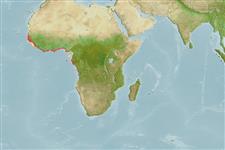
marino demersale; distribuzione batimetrica ? - 30 m (Ref. 114953). Tropical; 29°N - 17°S, 19°W - 13°E (Ref. 114953)
Eastern Atlantic: Morocco to southern Angola, a record from Namibia needs confirmation.
Dimensione / Peso / Età
Maturità: Lm ? range ? - ? cm
Max length : 100.0 cm TL maschio/sesso non determinato; (Ref. 6497); common length : 65.0 cm TL maschio/sesso non determinato; (Ref. 6497)
More or less stationary in inshore coastal waters to moderate depth. Feeds on benthic invertebrates, mainly crustaceans. Common length is 60-66 cm TL. Males mature at ca. 42 cm TL (Ref. 114953). Ovoviviparous. Produces small litters of 1-3 pups (Ref. 114953).
Ciclo vitale e comportamento di accoppiamento
Maturità | Riproduzione | Deposizione | Uova | Fecondità | Larve
Exhibit ovoviparity (aplacental viviparity), with embryos feeding initially on yolk, then receiving additional nourishment from the mother by indirect absorption of uterine fluid enriched with mucus, fat or protein through specialised structures (Ref. 50449).
Stehmann, M., 1990. Rhinobatidae. p. 23-27. In J.C. Quero, J.C. Hureau, C. Karrer, A. Post and L. Saldanha (eds.) Check-list of the fishes of the eastern tropical Atlantic (CLOFETA). JNICT, Lisbon; SEI, Paris; and UNESCO, Paris. Vol. 1. (Ref. 6497)
Stato della Lista Rossa IUCN (Ref. 130435: Version 2025-2 (Global))
Minaccia per l'uomo
Harmless
Usi umani
Strumenti
Rapporti speciali
Scarica XML
Fonti Internet
Stime basate su modelli
Temperatura preferita (Fonte Biblio.
123201): 25.1 - 28, mean 27.3 °C (based on 202 cells).
Indice di diversità filogenetica (Fonte Biblio.
82804): PD
50 = 0.5000 [Uniqueness, from 0.5 = low to 2.0 = high].
Bayesian length-weight: a=0.00295 (0.00150 - 0.00581), b=3.13 (2.96 - 3.30), in cm total length, based on LWR estimates for this (Sub)family-body shape (Ref.
93245).
Livello trofico (Fonte Biblio.
69278): 3.8 ±0.4 se; based on size and trophs of closest relatives
Resilienza (Fonte Biblio.
120179): Basso, tempo minimo di raddoppiamento della popolazione 4.5 - 14 anni (Fec assumed to be <100).
Vulnerabilità della pesca (Ref.
59153): High vulnerability (60 of 100).
🛈