>
Pleuronectiformes (Flatfishes) >
Soleidae (Soles)
Etymology: Dagetichthys: After Daget, French malacologist; he studied African fishes and Bivalves.
Environnement : milieu / zone climatique / profondeur / gamme de distribution
Écologie
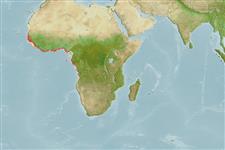
marin; saumâtre démersal; profondeur 0 - 125 m (Ref. 2683). Tropical; 21°N - 18°S, 19°W - 14°E
Eastern Atlantic: Cape Blanc (Mauritania) to Angola (Ref. 6805). Also in Mediterranean (Ref. 4710).
Taille / Poids / Âge
Maturité: Lm ? range ? - ? cm
Max length : 40.0 cm TL mâle / non sexé; (Ref. 6805); poids max. publié: 468.00 g (Ref. 126428)
Description synthétique
Clés d'identification | Morphologie | Morphométrie
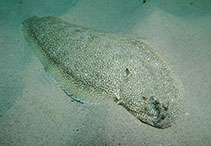
Épines dorsales (Total) : 0; Rayons mous dorsaux (Total) : 73 - 83; Épines anales: 0; Rayons mous anaux: 57 - 67. Diagnosis: body oval, elongate, flat and asymmetric (Ref. 57416), hind part tapering (Ref. 4710). Eyes located on right side of head, except in reversed individuals (Ref. 57416). Upper eye its own diameter or more from dorsal profile of head; anterior nostril on blind side not enlarged; anterior nostril on eyed side with backward-pointing tube not reaching front border of lower eye (Ref. 4710). Preopercle covered by skin and opercle entirely scaled; mouth arched and inferior; dorsal and anal fins lacking spinous rays and confluent with caudal fin, no distinct caudal peduncle; last dorsal and anal rays not shorter than preceding rays and broadly united to outer caudal rays; dorsal fin originating on anterior profile of head; pectoral fins present on both sides with 6-10 rays; straight part of lateral line visible, supratemporal part slightly arched above eyes; body covered with ctenoid scales (Ref. 57416).
Body shape (shape guide): other (see Diagnosis; Cross section: flattened.
Found on sand or mud bottoms (Ref. 2683, 4710) in shallow waters, from the shore to 60 m (Ref. 4710). No information available on diet or reproduction (Ref. 4710). Maximum depth from Ref. 122917.
Cycle de vie et comportement reproducteur
Maturité | Reproduction | Frai | Œufs | Fécondité | Larves
Vachon, J., F. Chapleau and M. Desoutter-Meniger, 2007. Révision taxonomique et phylogénie de Dagetichthys et Synaptura (Soleidae). Cybium 31(4):401-416. (Ref. 80029)
Statut dans la liste rouge de l'IUCN (Ref. 130435: Version 2025-2 (Global))
Menace pour l'homme
Harmless
Utilisations par l'homme
Pêcheries: commercial
Outils
Articles particuliers
Télécharger en XML
Sources Internet
Estimations basées sur des modèles
Température préférée (Réf.
123201): 23.2 - 28, mean 26.6 °C (based on 80 cells).
Indice de diversité phylogénétique (Réf.
82804): PD
50 = 0.6250 [Uniqueness, from 0.5 = low to 2.0 = high].
Bayesian length-weight: a=0.00631 (0.00365 - 0.01089), b=3.06 (2.91 - 3.21), in cm total length, based on LWR estimates for this species & (Sub)family-body (Ref.
93245).
Niveau trophique (Réf.
69278): 3.1 ±0.26 se; based on food items.
Résilience (Réf.
120179): Milieu, temps minimum de doublement de population : 1,4 à 4,4 années (Preliminary K or Fecundity.).
Vulnérabilité de la pêche (Ref.
59153): Low to moderate vulnerability (30 of 100).
🛈
Nutriments (Ref.
124155): Calcium = 156 [57, 342] mg/100g; Iron = 0.911 [0.425, 1.871] mg/100g; Protein = 17.8 [16.1, 19.7] %; Omega3 = 0.122 [0.059, 0.236] g/100g; Selenium = 61 [27, 125] μg/100g; VitaminA = 13.8 [4.3, 44.5] μg/100g; Zinc = 1.18 [0.77, 1.73] mg/100g (wet weight);