Klassifizierung / Names
Namen | Synonyme | Catalog of Fishes(Gattung, Arten) | ITIS | CoL | WoRMS | Cloffa
>
Pleuronectiformes (Flatfishes) >
Soleidae (Soles)
Etymology: Bathysolea: Greek, bathys = deep + Latin, solea = sandal (shoe); refered to the flat shape of the fish (Ref. 45335).
Taxonomic Remarks
Munroe in the Eastern Central Atlantic FAO catalogue (Carpenter et al,, 2016: Ref. 109259) only mentioned the species as doubtful.
Umwelt: Milieu / Klimazone / Tiefenbereich / Verbreitungsgebiet
Ökologie
seewasser bathypelagisch; tiefenbereich ? - 660 m (Ref. 5304). Deep-water; 16°N - 15°N
Eastern Central Atlantic: known only from the description of the holotype caught near Cape Verde.
Größe / Gewicht / Alter
Geschlechtsreife: Lm ? range ? - ? cm
Max length : 15.0 cm TL Männchen/unbestimmt; (Ref. 5304)
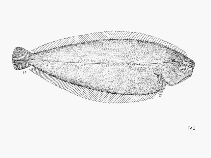
Rückenflossenweichstrahlen (insgesamt) : 92; Afterflossenweichstrahlen: 74; Wirbelzahl: 48. Uniformly pale yellowish in color with ctenoid scales on both sides of body; large nearly juxtaposed eyes covered partly with scaly 'eyelids'. Upper eye slightly in advance of lower eye and the snout is short. Teeth small and organized in rows, blind side teeth larger. Gular region distinctly separated by a deep groove from the body. Pectoral fins filamentous.
Body shape (shape guide): short and / or deep.
Lebenszyklus und Paarungsverhalten
Geschlechtsreife | Fortpflanzung | Ablaichen | Eier | Fruchtbarkeit | Larven
Desoutter, M., 1990. Soleidae. p. 1037-1049. In J.C. Quero, J.C. Hureau, C. Karrer, A. Post and L. Saldanha (eds.) Check-list of the fishes of the eastern tropical Atlantic (CLOFETA). JNICT, Lisbon; SEI, Paris; and UNESCO, Paris. Vol. 2. (Ref. 5304)
IUCN Rote Liste Status (Ref. 130435: Version 2025-2 (Global))
Bedrohung für Menschen
Harmless
Nutzung durch Menschen
Tools
Zusatzinformationen
Download XML
Internet Quellen
Schätzungen auf der Grundlage von Modellen
Phylogenetischer Diversitätsindex (Ref.
82804): PD
50 = 0.5625 [Uniqueness, from 0.5 = low to 2.0 = high].
Bayesian length-weight: a=0.00955 (0.00454 - 0.02011), b=3.07 (2.90 - 3.24), in cm total length, based on LWR estimates for this (Sub)family-body shape (Ref.
93245).
Trophische Ebene (Ref.
69278): 3.4 ±0.5 se; based on size and trophs of closest relatives
Widerstandsfähigkeit (Ref.
120179): mittel, Verdopplung der Population dauert 1,4 - 4,4 Jahre. (Assuming tmax>3).
Anfälligkeit der Fischerei (Ref.
59153): Low vulnerability (10 of 100).
🛈