Umwelt: Milieu / Klimazone / Tiefenbereich / Verbreitungsgebiet
Ökologie
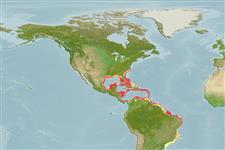
seewasser riff-verbunden; standorttreu; tiefenbereich 1 - 150 m (Ref. 26938), usually 1 - 40 m (Ref. 89707). Subtropical; 36°N - 28°S, 98°W - 33°W (Ref. 5222)
Western Atlantic: South Carolina, USA and Bermuda to southern Brazil.
Länge bei der ersten Reifung / Größe / Gewicht / Alter
Geschlechtsreife: Lm 14.7 range ? - 24.5 cm
Max length : 44.0 cm TL Männchen/unbestimmt; (Ref. 116036); max. veröff. Alter: 11 Jahre (Ref. 36271)
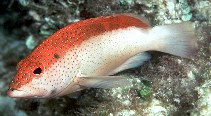
Rückenflossenstacheln (insgesamt) : 9; Rückenflossenweichstrahlen (insgesamt) : 14 - 16; Afterflossenstacheln: 3; Afterflossenweichstrahlen: 9. Body and fins red; many small blue spots edged with black line scattered on body; dorsal edge of caudal peduncle with 2 prominent black spots; a pair of black blotches on tip of lower jaw (Ref. 13608); depth of body 2.6-2.9 in SL; head length 2.3-2.5 in SL; flat interorbital area; rounded preopercle, with shallow notch above the angle with upper edge finely serrate and moderately enlarged, lower edge fleshy; subopercle and interopercle smooth; posterior and anterior nostrils small and subequal; scaly maxilla, reaching to or beyond vertical at rear edge of eye; caudal fin convex posteriorly, corners angular; ctenoid lateral-body scales (Ref. 089707).
Body shape (shape guide): fusiform / normal; Cross section: oval.
Adults prefer coral reefs and clear water. In the Gulf of Mexico, they are found in clear deep reefs (at least 45 m). At Bermuda and the West Indies, they are common in shallow water, but they usually hide in caves or under ledges during the day. The species is protogynous with females maturing at 16 cm TL and transforming to males at about 20 cm. Males are territorial. Feed mainly on small fishes and crustaceans. May follow morays and snake eels to feed on flushed preys. Wary, but approachable (Ref. 9710).
Mature females transform to males at a length of about 20 cm. Spawning occurs just before sunset over several days, and a male will spawn daily with each of the several females in his harem. Fecundity estimates range from about 150,000 to 282,000 eggs per female; with eggs 0.95 mm in diameter and having a single oil globule.
Heemstra, P.C. and J.E. Randall, 1993. FAO Species Catalogue. Vol. 16. Groupers of the world (family Serranidae, subfamily Epinephelinae). An annotated and illustrated catalogue of the grouper, rockcod, hind, coral grouper and lyretail species known to date. Rome: FAO. FAO Fish. Synop. 125(16):382 p. (Ref. 5222)
IUCN Rote Liste Status (Ref. 130435: Version 2025-2 (Global))
Bedrohung für Menschen
Reports of ciguatera poisoning (Ref. 30303)
Nutzung durch Menschen
Fischereien: kommerziell; Sportfisch: ja; Aquarium: Kommerziell
Tools
Zusatzinformationen
Download XML
Internet Quellen
Schätzungen auf der Grundlage von Modellen
Bevorzugte Temperatur (Ref.
123201): 24.4 - 28, mean 27 °C (based on 474 cells).
Phylogenetischer Diversitätsindex (Ref.
82804): PD
50 = 0.5000 [Uniqueness, from 0.5 = low to 2.0 = high].
Bayesian length-weight: a=0.01175 (0.00959 - 0.01439), b=3.04 (3.01 - 3.07), in cm total length, based on LWR estimates for this species (Ref.
93245).
Trophische Ebene (Ref.
69278): 4.1 ±0.4 se; based on diet studies.
Widerstandsfähigkeit (Ref.
120179): mittel, Verdopplung der Population dauert 1,4 - 4,4 Jahre. (tmax=11; K=0.14-0.63; Fec=67,000-280,000).
Prior r = 0.62, 95% CL = 0.41 - 0.93, Based on 2 data-limited stock assessments.
Anfälligkeit der Fischerei (Ref.
59153): High vulnerability (58 of 100).
🛈
Klimaanfälligkeit (Ref.
125649): High vulnerability (58 of 100).
🛈
Nährstoffe (Ref.
124155): Calcium = 24.9 [10.8, 55.0] mg/100g; Iron = 0.454 [0.230, 0.923] mg/100g; Protein = 19.2 [17.4, 20.9] %; Omega3 = 0.268 [0.145, 0.478] g/100g; Selenium = 20.8 [9.1, 42.0] μg/100g; VitaminA = 65.7 [20.5, 244.1] μg/100g; Zinc = 0.555 [0.365, 0.939] mg/100g (wet weight);