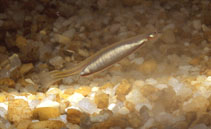
Klassifizierung / Names
Namen | Synonyme | Catalog of Fishes(Gattung, Arten) | ITIS | CoL | WoRMS | Cloffa
>
Siluriformes (Catfishes) >
Trichomycteridae (Pencil or parasitic catfishes) > Vandelliinae
Eponymy: Dr Domenico Agostino Vandelli (1735–1816) was an Italian naturalist who maintained a lengthy correspondence with Linnaeus. [...] (Ref. 128868), visit book page.
More on author: Valenciennes.
Umwelt: Milieu / Klimazone / Tiefenbereich / Verbreitungsgebiet
Ökologie
; süßwasser demersal. Tropical
South America: Amazon River basin.
Größe / Gewicht / Alter
Geschlechtsreife: Lm ? range ? - ? cm
Max length : 17.0 cm SL Männchen/unbestimmt; (Ref. 39970)
Enters the gill cavity of larger fish to suck blood; burrows in sandy bottoms. Known to enter the urethra of humans urinating under water; presumably it mistakes the urea for water exhausted from gills. When inactive, it remains buried in soft, muddy bottom. Active both during daytime and at night while foraging for blood (Ref. 50921). Uses visual and chemo-sensory orientation to find potential hosts (Ref. 50919, 50921). Forces itself under the gill cover of host fish to enter gill chamber during ventilation of the latter. Bites mostly at the ventral or dorsal aorta arteries, and the blood is pumped into its gut by the host's blood pressure. It does not need any special sucking or pumping mechanism to quickly engorge itself with blood, but simply uses its needle-like teeth to make an incision in an artery. Thus, the notion of the blood-sucking candiru is a misleading concept. Able to engorge itself enormously, the ingested blood is visible through the swollen belly. Some kind of valve or sphincter is likely present to prevent reflux of ingested blood. Time required to engorge itself with blood and leave host’s gill chamber ranges from 30 to 145 seconds. Some host fish species (Colossoma macropomum) are able to hamper candiru’s attacks by pressing it under the membranous gill-cover flap, or by using its pectoral fin to press it against the flank or to sweep it from the gill-cover edge (Ref. 50921).
Lebenszyklus und Paarungsverhalten
Geschlechtsreife | Fortpflanzung | Ablaichen | Eier | Fruchtbarkeit | Larven
de Pínna, M.C.C. and W. Wosiacki, 2003. Trichomycteridae (pencil or parasitic catfishes). p. 270-290. In R.E. Reis, S.O. Kullander and C.J. Ferraris, Jr. (eds.) Checklist of the Freshwater Fishes of South and Central America. Porto Alegre: EDIPUCRS, Brasil. (Ref. 39970)
IUCN Rote Liste Status (Ref. 130435: Version 2025-2 (Global))
Nutzung durch Menschen
Fischereien: nicht kommerziell
Tools
Zusatzinformationen
Download XML
Internet Quellen
Schätzungen auf der Grundlage von Modellen
Phylogenetischer Diversitätsindex (Ref.
82804): PD
50 = 0.6250 [Uniqueness, from 0.5 = low to 2.0 = high].
Bayesian length-weight: a=0.00389 (0.00180 - 0.00842), b=3.12 (2.94 - 3.30), in cm total length, based on all LWR estimates for this body shape (Ref.
93245).
Trophische Ebene (Ref.
69278): 4.4 ±0.80 se; based on food items.
Anfälligkeit der Fischerei (Ref.
59153): Low vulnerability (11 of 100).
🛈