Elasmobranquios (tiburones y rayas) (sharks and rays) >
Carcharhiniformes (Ground sharks) >
Carcharhinidae (Requiem sharks)
Etymology: Carcharhinus: karcharos (Gr.), sharp or jagged; rhinus, an ancient name for sharks, from rhine (Gr.), rasp, both words alluding to a shark's jagged, rasp-like skin (See ETYFish); plumbeus: Latin for “of lead,” i.e., lead-colored, referring to its gray-brown coloration above (See ETYFish).
More on author: Nardo.
Entorno: milieu / zona climática / rango de profundidad / gama de distribución
Ecología
marino; salobre bentopelágico; oceanodromo (Ref. 51243); rango de profundidad 0 - 500 m (Ref. 100719), usually 20 - 65 m (Ref. 55188). Subtropical; 23°C - 27°C (Ref. 244); 45°N - 41°S, 98°W - 154°W (Ref. 55188)
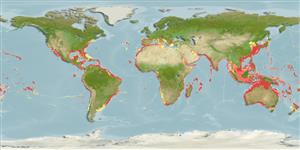
Widespread in tropical and warm-temperate waters worldwide.
Longitud en la primera madurez / Tamaño / Peso / Edad
Madurez: Lm 166.3, range 126 - 183 cm
Max length : 300 cm TL macho / no sexado; (Ref. 124786); common length : 200 cm TL macho / no sexado; (Ref. 9987); peso máximo publicado: 117.9 kg (Ref. 4699); edad máxima reportada: 34 años (Ref. 92315)
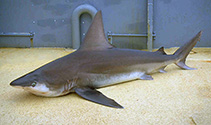
Espinas dorsales (total) : 0; Espinas anales: 0. A stout shark with a moderately long, rounded snout, high, triangular, saw-edged upper teeth, and an interdorsal ridge; 1st dorsal fin very large and erect (Ref. 5578). Grey-brown or bronzy with no prominent markings, white below (Ref. 5578). Fins plain or with slightly dusky tips (Ref. 5485).
Body shape (shape guide): fusiform / normal.
Found inshore and offshore, on continental and insular shelves and adjacent deep water (Ref. 244). Common at bays, river mouths and in harbors; avoids sandy beaches and the surf zone, coral reefs and rough bottom, and surface waters (Ref. 244). Coastal-pelagic, but usually bottom associated at 1-280 m (Ref. 58302). Sometimes in oceanic waters (Ref. 9997). Known to make extended seasonal migrations in some parts of its range (Ref. 6871). Feeds mainly on bony fishes, also small sharks, cephalopods, and shrimps (Ref. 5578), rays and gastropods (Ref. 5213). Youngs feed heavily on crustaceans such as blue crabd and mantis shrimp (Ref. 93252). Viviparous (Ref. 50449). Sexual dimorphism is evident in thickness of skin layer of maturing and adult females (Ref. 49562). Females live as long as 21 year; males 15 years (Ref. 27549). Populations are segregated by age. Young readily kept in aquaria (Ref. 244). Utilized for human consumption, for leather and oil (Ref. 244). Marketed fresh, smoked, dried-salted and frozen; fins are valued for soup (Ref. 9987). Used in Chinese medicine (Ref. 12166). Records to 300 cm TL uncertain (Ref. 9997). TL to 300 cm (Ref. 26938). Angling: an inshore fish and a good light-tackle fighter (Ref. 84357).
Viviparous (Ref. 26281), placental (Ref. 50449), 1-14 pups in a litter; 56-75 cm at birth (Ref. 2334); gestation period of 12 months (Ref.58048). Distinct pairing with embrace (Ref. 205). Sexual dimorphism is evident in the thicker skin layer of maturing and adult females (Ref. 49562). This thickened skin may serve as protection from the 'bites' the female species receive from the males during precopulation and in the rugged conditions of the rock and coral environment where they live (Ref. 49562). Pups are born from Feb. to April in Northeastern Taiwan (Ref. 37027).
Compagno, L.J.V., 1984. FAO Species Catalogue. Vol. 4. Sharks of the world. An annotated and illustrated catalogue of shark species known to date. Part 2 - Carcharhiniformes. FAO Fish. Synop. 125(4/2):251-655. Rome: FAO. (Ref. 244)
Situación en la Lista Roja de la UICN (Ref. 130435: Version 2025-2 (Global))
Amenaza para el ser humano
Usos humanos
Pesquerías: comercial; pesca deportiva: si
Herramientas
Fatal error: Uncaught mysqli_sql_exception: Too many connections in /var/www/html/includes/speciessummary.lib.php:1888
Stack trace:
#0 /var/www/html/includes/speciessummary.lib.php(1888): mysqli->__construct('mysql', 'fbuser', Object(SensitiveParameterValue), 'fbquizv2', '3306')
#1 /var/www/html/summary/SpeciesSummary.php(1851): checkRecordDisplayFBQuizV2('880', 'PicList')
#2 {main}
thrown in /var/www/html/includes/speciessummary.lib.php on line 1888