Ikan bertulang rawan (sharks and rays) >
Carcharhiniformes (Ground sharks) >
Carcharhinidae (Requiem sharks)
Etymology: Carcharhinus: karcharos (Gr.), sharp or jagged; rhinus, an ancient name for sharks, from rhine (Gr.), rasp, both words alluding to a shark's jagged, rasp-like skin (See ETYFish); perezii: In honor of Poey’s companion and friend Laureano Perez Arcas (1824-1894), University of Madrid, whose textbook Elementos de Zoología Poey used at the University of Havana (See ETYFish).
Eponymy: Professor Laureano Perez Arcas (1824–1894) was a Spanish entomologist and malacologist who became Professor of Zoology at the University of Madrid and Poey’s friend and companion. [...] (Ref. 128868), visit book page.
More on author: Poey.
Lingkungan: lingkungan / zona iklim / kisaran kedalaman / jangkauan distribusi
Ekologi
laut berasosiasi dengan karang; kisaran kedalaman 1 - 65 m (Ref. 9710), usually 1 - 35 m (Ref. 40849). Subtropical; 33°N - 35°S, 100°W - 33°W (Ref. 55187)
Western Atlantic: Florida, USA to southern Brazil, including the northern Gulf of Mexico and the Antilles.
Panjang pada saat jatuh tempo pertama / Ukuran / Berat / umur
Kematangan: Lm 160.0, range 152 - 168 cm
Max length : 300 cm TL jantan/; (Ref. 9710); 295.0 cm TL (female); Berat maksimum terpublikasi: 69.9 kg (Ref. 40637)
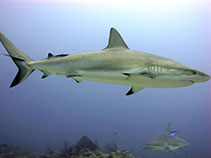
A large, gray shark with an interdorsal ridge and short blunt snout. 1st dorsal fin small with short rear tip (Ref. 26938).
Body shape (shape guide): fusiform / normal.
Found on continental and insular shelves, often near drop-offs on the outer edges of reefs. May rest on the bottom (Ref. 9710). Usually found in reefs, at less than 30 m deep (Ref 26938). Feed on bony fishes, including bigeyes (Priacanthidae). Viviparous (Ref. 50449). Size at birth below 73 cm. A dangerous species implicated in an abortive attack on divers in the Caribbean. Meat is prepared dried salted for human consumption, hides for leather, liver for oil, carcasses for fish meal.
Distinct pairing with embrace (Ref. 205). Viviparous, placental (Ref. 50449).
Compagno, L.J.V., 1984. FAO Species Catalogue. Vol. 4. Sharks of the world. An annotated and illustrated catalogue of shark species known to date. Part 2 - Carcharhiniformes. FAO Fish. Synop. 125(4/2):251-655. Rome: FAO. (Ref. 244)
Status IUCN Red List (Ref. 130435: Version 2025-2 (Global))
penggunaan manusia
Perikanan: komersial; Ikan buruan: ya
Alat, peralatan
laporan khas
muat turun XML
Sumber internet
Estimasi berdasarkan model
Suhu yang disukai (Acuan
123201): 25.3 - 28, mean 27.2 °C (based on 396 cells).
Indeks keanekaragaman filogenetik (Acuan
82804): PD
50 = 0.5000 [Uniqueness, from 0.5 = low to 2.0 = high].
Bayesian length-weight: a=0.00525 (0.00244 - 0.01130), b=3.07 (2.90 - 3.24), in cm total length, based on LWR estimates for this Genus-body shape (Ref.
93245).
Tingkat Trofik (Acuan
69278): 4.5 ±0.8 se; based on diet studies.
Daya lenting (Acuan
120179): Rendah, Waktu penggandaan populasi minimum 4.5 - 14 tahun (Fec assumed to be <100).
Kerentanan Penangkapan Ikan (Ref.
59153): Very high vulnerability (90 of 100).
🛈
Nutrisi (Ref.
124155): Calcium = 3.45 [0.66, 18.50] mg/100g; Iron = 0.348 [0.085, 1.010] mg/100g; Protein = 23 [20, 25] %; Omega3 = 0.145 [0.054, 0.363] g/100g; Selenium = 14.6 [4.6, 45.9] μg/100g; VitaminA = 28.1 [9.3, 88.8] μg/100g; Zinc = 0.333 [0.154, 0.655] mg/100g (wet weight);