>
Cichliformes (Cichlids, convict blennies) >
Cichlidae (Cichlids) > Etroplinae
Etymology: Paretroplus: Name from the Greek 'para' meaning 'on the side of'; in taxonomy it is commonly used in generic names to express similarity or relatedness; in the present case it would mean 'next to Etroplus' (S.Kullander, pers.comm. 3/11).
Eponymy: André Kiener was a French fisheries researcher who conducted numerous studies in Madagascar (1950s & 1960s). He wrote: Poissons, pêche et pisciculture à Madagascar (1963). (Ref. 128868), visit book page.
Milieu: milieu / Klimaatzone / Diepte / verspreidingsgebied
Ecologie
; zoet water demersaal. Tropical; 24°C - 28°C (Ref. 13614); 13°S - 20°S
Africa: northwestern Madagascar (Ref. 78623).
Grootte / Gewicht / Leeftijd
Maturiteit: Lm ? range ? - ? cm
Max length : 15.9 cm SL mannelijk / geslacht onbekend; (Ref. 78623)
Korte beschrijving
Determinatiesleutels | Morfologie | Morfometrie
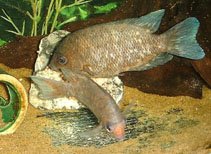
Dorsale stekels (totaal) : 18 - 20; Dorsale zachte stralen (totaal) : 13 - 15; Anale stekels: 9 - 11; Anale zachte stralen: 11 - 12. Diagnosis: A shallow-bodied Paretroplus distinguished from all congeners except P. gymnopreopercularis by the presence of a blotchy, mottled, and irregular pigmentation pattern, the absence of vertical bars on the flanks, and by a fleshy snout that extends rostral to the lips and also ventrally to cover a portion of the upper lip (Ref. 78623). Paretroplus kieneri is distinguished from its sister taxon, P. gymnopreopercularis, by the presence of a more or less fully scaled preopercle, except along the ventral margin, vs. completely asquamate; a pointed and mildly convex predorsal profile, vs. blunt and strongly convex; and a second lacrimal plate that forms a part, albeit small, of the orbit margin, vs. second lacrimal plate excluded from orbit margin; the pigmentation pattern of P. kieneri is conspicuously blotchy, mottled, and irregular, whereas P. gymnopreopercularis is characterized by a weakly mottled and especially uniform chain-link lateral pigmentation pattern, owing to darkly pigmented scale margins (Ref. 78623).
Body shape (shape guide): fusiform / normal.
Levenscyclus en paargedrag
Maturiteit | Voortplanting | Paaien | Eieren | Fecunditeit | Larven
Sparks, J.S., 2008. Phylogeny of the cichlid subfamily Etroplinae and taxonomic revision of the Malagasy cichlid genus Paretroplus (Teleostei: Cichlidae). Bull. Am. Mus. Nat. Hist. 314:1-151. (Ref. 78623)
Status op de Rode Lijst van het IUCN (Ref. 130435: Version 2025-2 (Global))
Gevaar voor de mens
Harmless
Gebruik door de mens
Tools
Speciale rapporten
Download XML
Internetbronnen
Schattingen op basis van modellen
Fylogenetische diversiteitsindex (Ref.
82804): PD
50 = 0.5001 [Uniqueness, from 0.5 = low to 2.0 = high].
Bayesian length-weight: a=0.01660 (0.00670 - 0.04111), b=2.95 (2.74 - 3.16), in cm total length, based on LWR estimates for this (Sub)family-body shape (Ref.
93245).
Trofisch niveau (Ref.
69278): 2.8 ±0.3 se; based on size and trophs of closest relatives
Weerstandsvermogen (Ref.
120179): Hoog, minimale populatieverdubbelingstijd minder dan 15 maanden (Preliminary K or Fecundity.).
Kwetsbaarheid van de visserij (Ref.
59153): Low vulnerability (10 of 100).
🛈