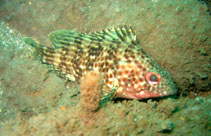
Environnement : milieu / zone climatique / profondeur / gamme de distribution
Écologie
marin démersal; non migrateur; profondeur ? - 30 m (Ref. 89707). Tropical; 32°N - 5°N, 115°W - 76°W (Ref. 5222)
Eastern Pacific: Gulf of California to Peru.
Taille / Poids / Âge
Maturité: Lm ? range ? - ? cm
Max length : 30.0 cm TL mâle / non sexé; (Ref. 55763); common length : 18.0 cm TL mâle / non sexé; (Ref. 55763)
Description synthétique
Clés d'identification | Morphologie | Morphométrie
Épines dorsales (Total) : 11; Rayons mous dorsaux (Total) : 18 - 20; Épines anales: 3; Rayons mous anaux: 9. Distinguished by the following characteristics: Dorsal fin with 11 spines and 18-20 rays: anal fin with 2 spines and 9 rays: pectoral fins with 17-19 rays; caudal fin rounded; smooth scales; lateral line scales 54-62; lateral line scale series 67-75; depth of body distinctly less than HL, depth contained 2.7-3.1 times in SL; caudal peduncle depth 11-12% SL; eye diameter slightly greater than snout length, 4.3-4.7 times HL; rounded preopercle, rear edge distinctly serrate with a large spine (usually hidden by skin) directed downward and forward at the angle; gill rakers 6-8 on upper limb, 14-16 on lower limb (Ref. 89707).
Body shape (shape guide): fusiform / normal.
A demersal, rocky reef (Ref. 89707) and shallow-water species, cryptically colored and secretive. Sedentary during the day, hiding in crevices or lying among seaweed, and rely on their effective camouflage to escape detection (sometimes lying and partly covering itself with sand). Nocturnal predators feeding mainly on benthic crustaceans.
Cycle de vie et comportement reproducteur
Maturité | Reproduction | Frai | Œufs | Fécondité | Larves
Heemstra, P.C. and J.E. Randall, 1993. FAO Species Catalogue. Vol. 16. Groupers of the world (family Serranidae, subfamily Epinephelinae). An annotated and illustrated catalogue of the grouper, rockcod, hind, coral grouper and lyretail species known to date. Rome: FAO. FAO Fish. Synop. 125(16):382 p. (Ref. 5222)
Statut dans la liste rouge de l'IUCN (Ref. 130435: Version 2025-2 (Global))
Menace pour l'homme
Harmless
Utilisations par l'homme
Pêcheries: sans intérêt
Outils
Articles particuliers
Télécharger en XML
Sources Internet
Estimations basées sur des modèles
Indice de diversité phylogénétique (Réf.
82804): PD
50 = 0.6250 [Uniqueness, from 0.5 = low to 2.0 = high].
Bayesian length-weight: a=0.01122 (0.00550 - 0.02289), b=3.04 (2.88 - 3.20), in cm total length, based on LWR estimates for this (Sub)family-body shape (Ref.
93245).
Niveau trophique (Réf.
69278): 3.5 ±0.50 se; based on food items.
Résilience (Réf.
120179): Haut, temps minimum de doublement de population inférieur à 15 mois (Assuming Fec > 10,000).
Vulnérabilité de la pêche (Ref.
59153): Low vulnerability (20 of 100).
🛈
Nutriments (Ref.
124155): Calcium = 165 [65, 306] mg/100g; Iron = 1.08 [0.59, 2.00] mg/100g; Protein = 17.6 [15.8, 19.3] %; Omega3 = 0.239 [0.141, 0.407] g/100g; Selenium = 44.5 [25.5, 86.9] μg/100g; VitaminA = 28.5 [10.4, 87.7] μg/100g; Zinc = 1.27 [0.91, 1.85] mg/100g (wet weight);