Klassifizierung / Names
Namen | Synonyme | Catalog of Fishes(Gattung, Arten) | ITIS | CoL | WoRMS | Cloffa
Elasmobranchii (Haie und Rochen) (sharks and rays) >
Torpediniformes (Electric rays) >
Hypnidae (Coffin rays)
Etymology: Hypnos: Greek, hypnos = sleep (Ref. 45335).
More on author: Shaw.
Umwelt: Milieu / Klimazone / Tiefenbereich / Verbreitungsgebiet
Ökologie
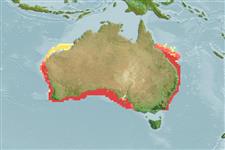
seewasser riff-verbunden; tiefenbereich 0 - 240 m (Ref. 9710). Temperate; 18°S - 38°S, 112°E - 155°E (Ref. 114953)
Indo-West Pacific: endemic to Australia.
Länge bei der ersten Reifung / Größe / Gewicht / Alter
Geschlechtsreife: Lm ?, range 24 - ? cm
Max length : 70.0 cm TL Männchen/unbestimmt; (Ref. 2272); common length : 40.0 cm TL Männchen/unbestimmt; (Ref. 6871)
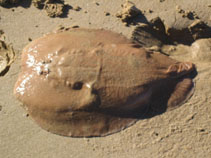
Occurs inshore and offshore, ranging from the intertidal to 240 m depth (Ref. 9910, 12951). Found buried on sand and mud bottoms; sometimes found stranded out of water by the tide but is capable of surviving for hours (Ref. 9910). Feeds on crabs, worms, and fishes. It was reported that larger fishes, similar size to themselves have been found in the stomachs of Coffin rays, ingested whole through the large gape (Ref. 114953). Ovoviviparous (Ref. 50449). Maximum length probably to 92 cm TL (Ref. 9910). Both sexes mature at 40-48 cm TL; born at ca. 8-11 cm TL (Ref. 114953). A slow-moving species which uses its electric organs to stun prey. Also stuns people when accidentally stepped upon or handled (Ref. 9910).
Lebenszyklus und Paarungsverhalten
Geschlechtsreife | Fortpflanzung | Ablaichen | Eier | Fruchtbarkeit | Larven
Exhibit ovoviparity (aplacental viviparity), with embryos feeding initially on yolk, then receiving additional nourishment from the mother by indirect absorption of uterine fluid enriched with mucus, fat or protein through specialised structures (Ref. 50449). Size at birth 8 to 11 cm TL (Ref. 9910).
Compagno, L.J.V., 1999. Checklist of living elasmobranchs. p. 471-498. In W.C. Hamlett (ed.) Sharks, skates, and rays: the biology of elasmobranch fishes. Johns Hopkins University Press, Maryland. (Ref. 35766)
IUCN Rote Liste Status (Ref. 130435: Version 2025-2 (Global))
Nutzung durch Menschen
Fischereien: nicht kommerziell
Tools
Zusatzinformationen
Download XML
Internet Quellen
Schätzungen auf der Grundlage von Modellen
Bevorzugte Temperatur (Ref.
123201): 15.3 - 22.2, mean 17.4 °C (based on 134 cells).
Phylogenetischer Diversitätsindex (Ref.
82804): PD
50 = 1.5000 [Uniqueness, from 0.5 = low to 2.0 = high].
Bayesian length-weight: a=0.01000 (0.00244 - 0.04107), b=3.04 (2.81 - 3.27), in cm total length, based on all LWR estimates for this body shape (Ref.
93245).
Trophische Ebene (Ref.
69278): 3.7 ±0.57 se; based on food items.
Anfälligkeit der Fischerei (Ref.
59153): Moderate to high vulnerability (48 of 100).
🛈
Nährstoffe (Ref.
124155): Calcium = 2.47 [0.28, 38.57] mg/100g; Iron = 0.157 [0.013, 1.622] mg/100g; Protein = 17.1 [13.0, 20.7] %; Omega3 = 0.302 [0.099, 0.903] g/100g; Selenium = 9.87 [1.75, 49.78] μg/100g; VitaminA = 21.6 [1.7, 276.9] μg/100g; Zinc = 0.479 [0.035, 5.305] mg/100g (wet weight);