分类 / 名称
俗名 | 同种异名 | Catalog of Fishes(属, 种) | ITIS | CoL | WoRMS | Cloffa
Petromyzonti >
Petromyzontiformes (Lampreys) >
Petromyzontidae (Northern lampreys) > Lampetrinae
Etymology: Caspiomyzon: Caspio, from the Caspian Sea basin, where C. wagneri is endemic; myzon (Gr.), to suck (borrowed from Petromyzon), referring to their suctorial behavior (See ETYFish); wagneri: In honor of Nicolai Petrivitsch Wagner (1829-1907), Kessler’s colleague at the Zoological Institute in St. Petersburg, Russia; Kessler described this lamprey from a specimen in Wagner’s collection (See ETYFish).
Eponymy: Professor Dr Nicolai Petrovitch Wagner (1829–1907) was a Russian zoologist particularly interested in entomology. [...] (Ref. 128868), visit book page.
Taxonomic Remarks
Berg (1931) suggested that this species consists of two races; a normal form (forma typica) and a smaller praecox form (Ref. 89241).
环境:氛围 / 气候带 / 深度上下限 / 分布范围
生态学
; 淡水; 半咸淡水 居于水底的; 溯河洄游 (Ref. 89241); 深度上下限 1 - 22 m (Ref. 89241). 溫帶; ? - 23°C (Ref. 59043); 59°N - 35°N, 42°E - 58°E (Ref. 59043)
Eurasia: endemic to the Caspian Sea drainage. Construction projects along the rivers entering the Caspian Sea have had a very negative impact. Very rare now in the Volga river (Ref. 12275). Migrates to uppermost tributaries of Volga (Ref. 59043). Reported to migrate for spawning to the Sura River and its tributaries (the Penza, Aiva, and Inza rivers) as far as Penza Ciry in the 1920s (Ref. 58030).
歐亞大陸: 裡海的特有種。 建築計畫沿著河,進入裡海已經有一個最負面的衝擊。 非常稀有的現在在窩瓦河中。
首次成熟时的长度 / 大小 / 重量 / 年龄
成熟度: Lm 32.5, range 19 - 46 cm
Max length : 55.3 cm TL 雄鱼/尚未辨别雌雄; (Ref. 12275); common length : 36.0 cm TL 雄鱼/尚未辨别雌雄; (Ref. 12275); common length :37 cm TL (female); 最大体重: 206.00 g (Ref. 12275); 最大年龄: 6 年 (Ref. 59043)
简单描述
检索表 | 型态特徵 | 形态测量图
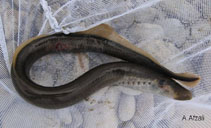
背棘 (总数) : 0; 背的软条 (总数) : 0. Adult: 19.0-55.3 cm TL; max. body wet weight, 206 g; body proportions, as percentage of TL (based on 129 specimens measuring 30.5-53.0 cm TL): 8.7-12.1 prebranchial length, 7.7-11.0 branchial length, 43.6-57.6 trunk length (derived by deduction; represents a maximum possible range), 26-33 tail length, 0.8-2.2 eye length and 2.4-4.5 disc length; intestinal diameter in prespawning individuals has a mean of 0.27 cm and in spawning individuals a mean of 0.14 cm; urogenital papilla length (percentage of branchial length in 5 spawning males 30.1-34.4 cm TL), 14.3-21.2; trunk myomeres, 63-66. Adult dentition: supraoral lamina, one unicuspid (sometimes bicuspid) tooth; infraoral lamina, 4-6, usually 5, unicuspid teeth, but sometimes the lateralmost ones are bicuspid; 4 endolaterals on each side; endolateral formula, typically 1-1-1-1; 3-5 rows of anterials; first row of anterials, 3 unicuspid teeth; 8 rows of exolaterals on each side; 3 rows of posterials; first row of posterials, 11 unicuspid teeth; transverse lingual lamina straight, 5-8 unicuspid teeth, the median one not enlarged; longitudinal lingual laminae with undetermined number of unicuspid teeth. Velar tentacles in adults, 3, long and bearing papillae; body coloration in prespawning adults, dark gray on dorsal and lateral aspects and silvery white ventrally; spawning adults are black on dorsal and lateral aspects and gray with dark oval spots ventrally; color of eggs in prespawning females, light gray or yellow, while in spawning females is bluish-green; lateral line neuromasts unpigmented; caudal fin pigmentation unrecorded; caudal fin shape, spade-like; oral fimbriae, 93-115; oral papillae, 24-31(Ref. 89241).
Body shape (shape guide): eel-like; Cross section: circular.
Non-parasitic (Ref. 59043). Ammocoetes burrow 1-2 cm deep in substrates containing sand, clay, and detritus, in areas with slow current, and at water depths 0.3-22 m; also on surface of substrate among macrophytes and submerged wood. Metamorphosing individuals occur in areas with faster current, devoid of macrophytes, and in deeper water. Adults in rivers and marine waters; in shallow lakes in flood plain of the Volga River delta. Larval life is 3 years in the Volga River Basin and 2-4 years in the Kura River Basin. Ammocoetes feed on diatoms and detritus; feeding activity highest in summer, lowest in the winter. Metamorphosis begins in mid-July in the Volga River (Russian Federation); end of August to early September in the Kura River (Azerbaijan); and October in Iran (Islamic Republic of). Metamorphosing ammocoetes do not feed. Anadromous. Adult life at least 17 months. Indications that adults feed as scavengers or might feed on demersal fish eggs or on some invertebrates; feeding habits still subject of speculation since their teeth are blunt, yet their intestine remains functional and they grow considerably post-metamorphosis. Adults on their spawning run will attach, particularly in the opercular region, to likewise upstream-migrating winter form of brown sea trout (Salmo trutta caspius). Prespawning adults in the Kama River, Russian Federation, serve as a host for unionid glochidia, which attach to its gills. Spawning run is nocturnal; up the Kura River in November-February and Volga River, mid-September-March. Upstream migrants swim near the surface on dark nights and close to the river bottom on moonlit nights. During the day, they stay among stones on the bottom. Max. distance traveled, 1,500 km for larger individuals. Swimming speed, 2-16 km/day. Beginning migration, fat content of adult as high as 34% by body weight, terminating on spawning grounds with as low as 1-2% by body weight, at first concealing themselves amongst stones or burrow into the substrate, and later, swim and periodically break the water’s surface with their heads. Spawning in mid-March to mid-July over sandy and rocky substrate, at water temperatures 15-23 ˚C. Spawning grounds along the entire courses of the Volga and Kura rivers from estuaries to the upper reaches historically, and to man-made reservoirs presently. Redds are constructed by both sexes in sand and gravel substrates, usually in shallow waters. Fecundity, 14,000-60,000 eggs/female. Ammocoetes hatch 8-10 days after fertilization at lengths of 0.33-0.42 cm. Three to four days after hatching, yolk sac is almost completely absorbed. Volga River fishery carried out in both the spring and autumn, with over 75% of the catch occurring in autumn. Between 1910 and 1913 inclusively, from 16,900,000 to 33,400,000 Caspian Lamprey were harvested annually. Kura River fishery catches compiled in five-year increments from 1881 to 1935 with lowest record of 11,000 lamprey for the period 1891-1895 and highest of 612,000 lamprey for the period 1911-1915; 213,000 annual lamprey catch in 1936 and 304,000 in 1937; lipid content is 30.3% of the body weight. Prior to 1868, the catch was dried and used as a substitute for candles, and after 1868, it was harvested as food for humans. The caloric value for Caspian Lamprey is 3.4 kcal/g wet weight. Water regulation projects on the Volga and Kura rivers with deleterious effects on the abundance of Caspian Lamprey, preventing access to areas above the Volgograd and Mingechaur reservoirs, respectively, that it is no longer considered a commercially important species. There are reports of intoxication through eating this species (Ref. 89241).
非寄生的八目鳗。 幼八目鳗达到 13 mm TL 而且达到 3 岁。 他们生活于底部沈积层而且吃硅藻与碎屑。 在成鱼的肠, 只有那藻类保持与较高等的植物被发现。 然而,他们也可能吃死的鱼而且被知道把自己吸附到鳟鱼,可能对于传送。 体全长减少22% 被预先产卵到产卵期的从。 成鱼在产卵之后死亡。 肉被报告是有毒 (ichthyosarcotoxic) 而且一定要在消费之前处理。 直到 1868, 所有的捕获都被晒乾而且用作蜡烛或制成鱼油。 它被当作人类的食物使用, 而且现在被认为是一个有价值而可口的鱼不过往后。
The nest is dug by either the male or the female. They attach themselves to stones before mating. Females die immediately after releasing their eggs, but males survive until spermatogenesis ceases and can mate with more than one female (Ref. 12275). Ammocoete stage lasts 2-4 years in freshwater after which metamorphosed juveniles migrate to the sea (Ref. 59043). In lower Volga, adults may feed one or two summers before breeding (Ref. 59043). These adults may begin to migrate to rivers in autumn and winter, usually from October to February, unstopped by ice flow in Volga (Ref. 59043).歐亞大陸: 裡海的特有種。 建築計畫沿著河,進入裡海已經有一個最負面的衝擊。 非常稀有的現在在窩瓦河中。
Holcík, J., 1986. Caspiomyzon wagneri (Kessler, 1870). p. 119-142. In J. Holcik (ed.) The Freshwater fishes of Europe. Vol.1, Part I, Petromyzontiformes. (Ref. 12275)
世界自然保护联盟红皮书 (Ref. 130435: Version 2025-2 (Global))
人类利用
渔业: 商业性; 养殖: 实验的
工具
特别资料
下载 XML
网络资源
基于模型的估算
系统发育多样性指数 (参考文献
82804): PD
50 = 0.6250 [Uniqueness, from 0.5 = low to 2.0 = high].
Bayesian length-weight: a=0.00120 (0.00088 - 0.00164), b=2.96 (2.88 - 3.04), in cm total length, based on LWR estimates for this species (Ref.
93245).
营养阶层 (参考文献
69278): 4.0 ±1.00 se; based on food items.
回复力 (参考文献
120179): 低的, 最小族群倍增时间4.5 - 14 年 (Semelparous species, assuming tm (= tmax) > 4).
渔业脆弱性 (Ref.
59153): Moderate vulnerability (42 of 100).
🛈