Lớp cá viên khẩu (Myxini) (hagfishes) >
Myxiniformes (Hagfishes) >
Myxinidae (Hagfishes) > Eptatretinae
Etymology: Eptatretus: hepta (Gr.), seven; tretos (Gr.), perforated (i.e., with holes), referring to seven gill apertures on what would later be described as Homea banksii (=E. cirrhatus) [range within genus is 6-14 pairs of gill apertures] (See ETYFish); springeri: In honor of American shark biologist Stewart Springer (1906-1991), then with the U.S. Fish and Wildlife Service, “who discovered this interesting cyclostome” (See ETYFish).
Eponymy: Stewart ‘Stew’ Springer (1906–1991) was a field naturalist who dropped out of Butler College (1929) but was awarded a baccalaureate by George Washington University (1964), by which time he was world-renowned as an expert on both the taxonomy and [...] (Ref. 128868), visit book page.
Môi trường: môi trường / vùng khí hậu / Mức độ sâu / phạm vi phân phối
Sinh thái học
biển tầng đáy biển sâu; không di cư; mức độ sâu 400 - 730 m (Ref. 31276). Deep-water
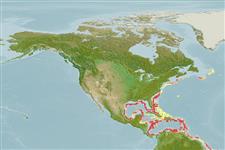
Western Central Atlantic: Northeastern Gulf of Mexico.
Bộ gần gũi / Khối lượng (Trọng lượng) / Tuổi
Chín muồi sinh dục: Lm ? range ? - ? cm
Max length : 59.0 cm TL con đực/không giới tính; (Ref. 31276)
Mô tả ngắn gọn
Khóa để định loại | Hình thái học | Sinh trắc học
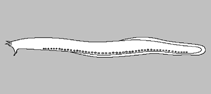
Gill apertures 6. Slime pores: prebranchial 16-19; branchial 2-5; trunk 52-57; tail 9-13; total 84-92.
Body shape (shape guide): eel-like.
Vòng đời và hành vi giao phối
Chín muồi sinh dục | Sự tái sinh sản | Đẻ trứng | Các trứng | Sự sinh sản | Ấu trùng
Copulatory organ absent. The gonads of hagfishes are situated in the peritoneal cavity. The ovary is found in the anterior portion of the gonad, and the testis is found in the posterior part. The animal becomes female if the cranial part of the gonad develops or male if the caudal part undergoes differentiation. If none develops, then the animal becomes sterile. If both anterior and posterior parts develop, then the animal becomes a functional hermaphrodite. However, hermaphroditism being characterised as functional needs to be validated by more reproduction studies (Ref. 51361 ).
Fernholm, B., 1998. Hagfish systematics. p. 33-44. In J.M. Jørgensen, J.P. Lomholt, R.E. Weber and H. Malte (eds.) The biology of hagfishes. Chapman & Hall, London. 578 p. (Ref. 31276)
Tình trạng Sách đỏ IUCN (Ref. 130435: Version 2025-2 (Global))
Mối đe dọa đối với con người
Harmless
Sử dụng của con người
Các nghề cá: không ích lợi (thú vị)
Các công cụ
Báo cáo đặc biệt
Tải xuống XML
Các nguồn internet
Ước tính dựa trên mô hình
Nhiệt độ ưa thích (Tài liệu tham khảo
123201): 8.2 - 14.6, mean 11.3 °C (based on 64 cells).
Chỉ số đa dạng phát sinh loài (Tài liệu tham khảo
82804): PD
50 = 0.5000 [Uniqueness, from 0.5 = low to 2.0 = high].
Bayesian length-weight: a=0.00204 (0.00094 - 0.00444), b=2.92 (2.72 - 3.12), in cm total length, based on LWR estimates for this (Sub)family-body shape (Ref.
93245).
Mức dinh dưỡng (Tài liệu tham khảo
69278): 4.2 ±0.7 se; based on size and trophs of closest relatives
Thích nghi nhanh (Tài liệu tham khảo
120179): thấp, thời gian nhân đôi của chủng quần tối thiểu là 4.5 - 14 năm (Fec assumed to be <100).
Sự dễ bị tổn thương của nghề đánh cá (Ref.
59153): Moderate vulnerability (44 of 100).
🛈