Myxini (mixinas) (hagfishes) >
Myxiniformes (Hagfishes) >
Myxinidae (Hagfishes) > Eptatretinae
Etymology: Eptatretus: hepta (Gr.), seven; tretos (Gr.), perforated (i.e., with holes), referring to seven gill apertures on what would later be described as Homea banksii (=E. cirrhatus) [range within genus is 6-14 pairs of gill apertures] (See ETYFish); burgeri: In honor of German physicist and biologist Heinrich Bürger (ca. 1804-1858), who collected type (See ETYFish).
Eponymy: Dr Heinrich Bürger (1804/06*-1858) was a German physicist and biologist employed by the Dutch government. [...] (Ref. 128868), visit book page.
More on author: Girard.
Ambiente: milieu / zona climática / intervalo de profundidade / gama de distribuição
Ecologia
marinhas demersal; não migratória; intervalo de profundidade 10 - 270 m (Ref. 31276). Temperate
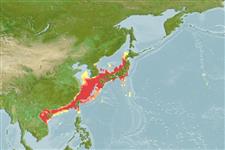
Northwest Pacific: Sea of Japan and eastern Japan to Taiwan.
Tamanho / Peso / Idade
Maturidade: Lm ? range ? - ? cm
Max length : 60.0 cm TL macho/indeterminado; (Ref. 559)
Six pairs of gill pouches and gill apertures in a rarely variable linear arrangement. Branchial slime pores, 4-6. The last left gill aperture (GA) is closely adjacent to but separate from the pharyngocutaneous duct (PCD). Eyes spots are prominent (Ref. 31545). White mid-dorsal line prominent; fused cusps 3/2, total cusps 40-42; total slime pores 81-92 (Ref. 51420).
Body shape (shape guide): eel-like.
Found in the sublittoral zone (Ref. 11230). Usually buries itself in bottom mud (Ref. 26686). Migrates into deeper water to spawn (Ref. 51361, 51374). This is the only member of the family having a seasonal reproductive cycle (Ref. 51361). Food fish in Japan. Hide is processed into leather and exported worldwide, usually as 'eel' leather.
Ciclo de vida e comportamento de acasalamento
Maturidade | Reprodução | Desova | Ovos | Fecundidade | Larvas
Copulatory organ absent. The gonads of hagfishes are situated in the peritoneal cavity. The ovary is found in the anterior portion of the gonad, and the testis is found in the posterior part. The animal becomes female if the cranial part of the gonad develops or male if the caudal part undergoes differentiation. If none develops, then the animal becomes sterile. If both anterior and posterior parts develop, then the animal becomes a functional hermaphrodite. However, hermaphroditism being characterised as functional needs to be validated by more reproduction studies (Ref. 51361 ). However, there was a presumption of 0.1% or even less that this species manifests functional hermaphroditism (Ref. 51416).
This is the only member of the family having a seasonal reproductive cycle (Ref. 51361).
Fernholm, B., 1998. Hagfish systematics. p. 33-44. In J.M. Jørgensen, J.P. Lomholt, R.E. Weber and H. Malte (eds.) The biology of hagfishes. Chapman & Hall, London. 578 p. (Ref. 31276)
Categoria na Lista Vermelha da IUCN (Ref. 130435: Version 2025-2 (Global))
Ameaça para o homem
Harmless
Utilização humana
Pescarias: espécies comerciais; isco: usually
Ferramentas
Relatórios especiais
Descarregue XML
Fontes da internet
Estimativas baseadas em modelos
Temperatura preferida (Ref.
123201): 11.1 - 23.4, mean 18.8 °C (based on 182 cells).
Índice de diversidade filogenética (Ref.
82804): PD
50 = 0.5000 [Uniqueness, from 0.5 = low to 2.0 = high].
Bayesian length-weight: a=0.00204 (0.00094 - 0.00444), b=2.92 (2.72 - 3.12), in cm total length, based on LWR estimates for this (Sub)family-body shape (Ref.
93245).
Nível Trófico (Ref.
69278): 4.5 ±0.80 se; based on food items.
Resiliência (Ref.
120179): Baixo, tempo mínimo de duplicação da população 4,5 - 14 anos (Fec assumed to be <100).
Vulnerabilidade da pesca (Ref.
59153): Moderate vulnerability (44 of 100).
🛈