Elasmobranchii (Haie und Rochen) (sharks and rays) >
Carcharhiniformes (Ground sharks) >
Carcharhinidae (Requiem sharks)
Etymology: Carcharhinus: karcharos (Gr.), sharp or jagged; rhinus, an ancient name for sharks, from rhine (Gr.), rasp, both words alluding to a shark's jagged, rasp-like skin (See ETYFish); fitzroyensis: -ensis, Latin suffix denoting place: Fitzroy River, Queensland, type locality (See ETYFish).
Eponymy: This is a toponym; the holotype was collected in the estuary of the Fitzroy River, Western Australia. (Ref. 128868), visit book page.
More on author: Whitley.
Umwelt: Milieu / Klimazone / Tiefenbereich / Verbreitungsgebiet
Ökologie
seewasser; brackwasser demersal; tiefenbereich 0 - 40 m (Ref. 6871). Subtropical; 10°S - 26°S
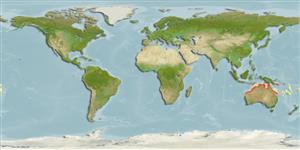
Western Pacific: northern Australia, from Western Australia to Queensland. Recorded in the Arafura Sea (Ref. 9819).
Länge bei der ersten Reifung / Größe / Gewicht / Alter
Geschlechtsreife: Lm 94.5, range 89 - 100 cm
Max length : 135 cm TL Männchen/unbestimmt; (Ref. 6871)
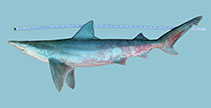
Rückenflossenstacheln (insgesamt) : 0; Afterflossenstacheln: 0. Bronze above, fading to grayish brown after death and in preserved specimens; light below, without conspicuous markings on fins; no conspicuous white band on flanks (Ref. 9997).
Body shape (shape guide): fusiform / normal.
A little-known shark found inshore and offshore on the continental shelves from the intertidal to at least 40 m depth (Ref. 9997). Feeds mainly on teleost fishes, also crustaceans (Ref. 6871). Viviparous (Ref. 50449). Utilized for human consumption (Ref. 244, 9997) and probably for the oriental shark fin trade (Ref. 244).
Viviparous, placental (Ref. 50449). Females give birth to 1-7 pups every year between February and May (Ref. 6871). Size at birth about 50 cm (Ref. 6871). Distinct pairing with embrace (Ref. 205).
Compagno, L.J.V., 1984. FAO Species Catalogue. Vol. 4. Sharks of the world. An annotated and illustrated catalogue of shark species known to date. Part 2 - Carcharhiniformes. FAO Fish. Synop. 125(4/2):251-655. Rome: FAO. (Ref. 244)
IUCN Rote Liste Status (Ref. 130435: Version 2025-2 (Global))
Bedrohung für Menschen
Harmless
Nutzung durch Menschen
Fischereien: weniger kommerziell
Tools
Zusatzinformationen
Download XML
Internet Quellen
Schätzungen auf der Grundlage von Modellen
Bevorzugte Temperatur (Ref.
123201): 26.1 - 28.7, mean 27.7 °C (based on 294 cells).
Phylogenetischer Diversitätsindex (Ref.
82804): PD
50 = 0.5000 [Uniqueness, from 0.5 = low to 2.0 = high].
Bayesian length-weight: a=0.00331 (0.00185 - 0.00593), b=3.07 (2.92 - 3.22), in cm total length, based on LWR estimates for this species & Genus-body shape (Ref.
93245).
Trophische Ebene (Ref.
69278): 4.1 ±0.6 se; based on size and trophs of closest relatives
Widerstandsfähigkeit (Ref.
120179): sehr niedrig, Verdopplung der Population dauert mehr als 14 Jahre. (Fec=1).
Anfälligkeit der Fischerei (Ref.
59153): Very high vulnerability (81 of 100).
🛈