Ambiente: milieu / zona climática / intervalo de profundidade / gama de distribuição
Ecologia
; Água doce; estuarina bentopelágico; potamódromo (Ref. 593). Temperate
Europe and Asia: some upper tributaries of Pechora and Kama (with tributaries Vyatka, Belaya, Vishera, Chusovaya) in Volga drainage; Siberia from Ob' to Yana drainages; Amur and some adjacent drainages. Prior to the impoundment of Kama, used to enter Volga and to reach downriver to Samara.
Comprimento na primeira maturidade / Tamanho / Peso / Idade
Maturidade: Lm ? range ? - ? cm
Max length : 200 cm SL macho/indeterminado; (Ref. 59043); peso máx. Publicado: 105.0 kg (Ref. 59043); Idade máx. registada: 55 anos (Ref. 56502)
Descrição breve
Chaves de identificação | Morfologia | Morfometria
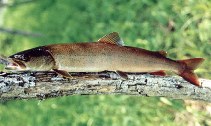
Small cross-shaped dark spots on head and sides of body; maxilla reaching backward behind rear edge of eyes; scales oval, minute without radial grooves and rings extremely clear; adipose fin well-developed; pyloric caecum 205-219 (Ref. 45563). Distinguished from other species of Salmonidae in central and eastern Europe by the combination of the following characters: teeth on vomer and palatine in a continuous, horse-shoe-shaped band; 173-288 scales in midlateral row (107-164 pored scales); small round dark spots on head and dark x-shaped or/and half-moon-shaped spots on body; head long (22-25% SL) and dorsally flattened; very long jaws, maxilla length 42-50% HL; in adults, maxilla reaching posterior margin of eye; shallow cylindrical body; caudal deeply emarginate, reddish in adults; large size in undisturbed areas; and 9-18 gill rakers, usually 11-13 (Ref. 59043).
Body shape (shape guide): fusiform / normal.
Adults inhabit piedmont and montane cold rivers with high oxygen concentrations. They prefer to live in deeper holes with slow current for periods of reduced activity (day time, winter), but also lower reaches, estuaries, cold lakes and reservoirs. Both juveniles and adults are territorial. Adults frequently occur within their own restricted territory (deep holes below rapids and waterfalls, confluence of small tributaries, below bridge pillar or large rocks, bank excavations), which they abandon only foraging and spawning. Young individuals do not maintain permanent territory. Juveniles occur in fast-flowing waters, prey on drifting invertebrates and shift to fish diet after 1-3 years. Adults feed on fishes and terrestrial vertebrates. They breed in shallow places with fast current on pebble bottom, immediately downstream of large deep pools, often in small river tributaries. Usually undertake upriver migration for spawning in the upper reaches of tributaries. Can overcome quite high obstacles while migrating to spawning sites. Eggs, 5-6 mm in diameter, hatch after 28-38 days. Alevins stay in gravel until yolk sac is absorbed after 10-15 days while young first remain near spawning site, then move downstream. Larger immature individuals of 2-4 years of age live in same sites as adults but separately below groups of adults or in smaller holes. Life span reaches up to about 20 years (Ref. 59043). Threatened due to habitat loss, pollution and over harvesting (Ref. 58490), including angling tourism (Ref. 59043).
Females dig a redd about 1.0-1.5 m in diameter. Eggs, 5-6 mm in diameter, hatch after 28-38 days. Alevins stay in gravel until yolk sac is absorbed after 10-15 days while young first remain near spawning site, then move downstream (Ref. 59043).
Kottelat, M. and J. Freyhof, 2007. Handbook of European freshwater fishes. Publications Kottelat, Cornol and Freyhof, Berlin. 646 pp. (Ref. 59043)
Categoria na Lista Vermelha da IUCN (Ref. 130435: Version 2025-2 (Global))
Ameaça para o homem
Harmless
Utilização humana
Pescarias: espécies comerciais; Aquacultura: experimental; peixe desportivo: sim
Ferramentas
Relatórios especiais
Descarregue XML
Fontes da internet
Estimativas baseadas em modelos
Índice de diversidade filogenética (Ref.
82804): PD
50 = 0.5625 [Uniqueness, from 0.5 = low to 2.0 = high].
Bayesian length-weight: a=0.00933 (0.00617 - 0.01411), b=3.04 (2.92 - 3.16), in cm total length, based on LWR estimates for this species & (Sub)family-body (Ref.
93245).
Nível Trófico (Ref.
69278): 4.5 ±0.3 se; based on diet studies.
Resiliência (Ref.
120179): Muito baixo, tempo mínimo de duplicação da população maior que 14 anos (tm=5; tmax=55; Fec=44,000).
Vulnerabilidade da pesca (Ref.
59153): Very high vulnerability (76 of 100).
🛈