Elasmobranchi (squali e razze) (sharks and rays) >
Carcharhiniformes (Ground sharks) >
Carcharhinidae (Requiem sharks)
Etymology: Carcharhinus: karcharos (Gr.), sharp or jagged; rhinus, an ancient name for sharks, from rhine (Gr.), rasp, both words alluding to a shark's jagged, rasp-like skin (See ETYFish); falciformis: falx (L.), scythe or sickle; forma (L.), shape or form, referring to sickle-like shape of pectoral fins [authorship often attributed to Müller & Henle, who published Bibron’s description] (See ETYFish).
Ambiente: milieu / zona climatica / distribuzione batimetrica / gamma di distribuzione
Ecologia
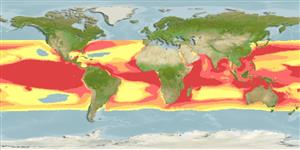
marino associati a barriera corallina; oceanodromo (Ref. 87829); distribuzione batimetrica 0 - 4000 m (Ref. 55180), usually 0 - 500 m (Ref. 6871). Subtropical; 42°N - 43°S, 180°W - 180°E (Ref. 55180)
Circumtropical. Western Atlantic: Massachusetts, USA to southern Brazil, including the Gulf of Mexico and the Caribbean Sea to Uruguay (Ref. 244, 58839). Eastern Atlantic: Spain, Madeira to northern Angola; St. Paul's Rocks (Ref. 13121); Cape Verde (Ref. 34514). Indo-Pacific: scattered records from the Red Sea and Natal, South Africa (Ref. 5578) to China, New Zealand, and the Caroline, Hawaiian, Phoenix and Line islands. Eastern Pacific: southern Baja California, Mexico to northern Chile. Highly migratory species.
Lunghezza alla prima maturità / Dimensione / Peso / Età
Maturità: Lm 219.1, range 180 - 260 cm
Max length : 350 cm TL maschio/sesso non determinato; (Ref. 9997); common length : 250 cm TL maschio/sesso non determinato; (Ref. 9997); peso massimo pubblicato: 346.0 kg (Ref. 40637); Età massima riportata: 25 anni (Ref. 31395)
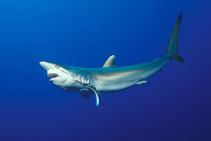
Spine dorsali (totale) : 0; Spine anali: 0. A large, slim shark with a moderately long, flat and rounded snout, large eyes, small jaws, and oblique-cusped teeth with serrations; 2nd dorsal fin low and with greatly elongated rear tip (Ref. 5578). Grey or bluish-grey above, white below; no conspicuous fin markings (Ref. 5578). Only Carcharhinus species with an interdorsal ridge that has the dorsal fin origin behind the free rear tip of the pectoral fin (Ref. 26938).
Body shape (shape guide): fusiform / normal.
Found abundantly near the edge of continental and insular shelves, but also in the open sea and occasionally inshore (Ref. 244). Often found in deepwater reefs and near insular slopes (Ref. 244). Littoral and epipelagic, in the open sea or near the bottom at 18-500 m (Ref. 58302). It is quick-moving and aggressive (Ref. 244). Solitary (Ref. 26340); often associated with schools of tuna (Ref. 244). Feeds mainly on fishes, but also squid, paper nautiluses, and pelagic crabs (Ref. 244; 37816). Viviparous (Ref. 50449). Regarded as dangerous to humans (Ref. 9997). Flesh utilized fresh and dried-salted for human consumption; its hide for leather; its fin for shark-fin soup; its liver for oil (Ref. 244). 2 to 14 young, 73 to 87 cm, are born per litter (Ref. 1602).
Viviparous, placental (Ref. 50449). 2-15 pups (Ref. 6871, 37816) born at 57-87 cm TL (Ref. 9997); 1-16 pups born at 55-72 cm TL. Females appear to breed every year, but there appears to be no reproductive seasonality (Ref. 58048). Distinct pairing with embrace (Ref. 205).
Compagno, L.J.V., 1984. FAO Species Catalogue. Vol. 4. Sharks of the world. An annotated and illustrated catalogue of shark species known to date. Part 2 - Carcharhiniformes. FAO Fish. Synop. 125(4/2):251-655. Rome: FAO. (Ref. 244)
Stato della Lista Rossa IUCN (Ref. 130435: Version 2025-2 (Global))
Minaccia per l'uomo
Traumatogenic (Ref. 9997)
Usi umani
Pesca: elevato interesse commerciale
Strumenti
Rapporti speciali
Scarica XML
Fonti Internet
Stime basate su modelli
Temperatura preferita (Fonte Biblio.
123201): 12 - 28.9, mean 26.7 °C (based on 8170 cells).
Indice di diversità filogenetica (Fonte Biblio.
82804): PD
50 = 0.5000 [Uniqueness, from 0.5 = low to 2.0 = high].
Bayesian length-weight: a=0.00501 (0.00408 - 0.00616), b=3.07 (3.03 - 3.11), in cm total length, based on LWR estimates for this species (Ref.
93245).
Livello trofico (Fonte Biblio.
69278): 4.5 ±0.0 se; based on diet studies.
Generation time: 9.2 (7.4 - 13.1) years. Estimated as median ln(3)/K based on 14
growth studies.
Resilienza (Fonte Biblio.
120179): Basso, tempo minimo di raddoppiamento della popolazione 4.5 - 14 anni (rm=0.054; K=0.05-0.15; tm=6-10; tmax=25; Fec=2-14).
Prior r = 0.06, 95% CL = 0.04 - 0.09, Based on 3 data-limited stock assessments.
Vulnerabilità della pesca (Ref.
59153): Very high vulnerability (82 of 100).
🛈
Vulnerabilità climatica (Ref.
125649): Very high vulnerability (76 of 100).
🛈
Nutrienti (Ref.
124155): Calcium = 2.41 [0.46, 12.84] mg/100g; Iron = 0.321 [0.080, 0.980] mg/100g; Protein = 22.8 [19.9, 25.0] %; Omega3 = 0.211 [0.078, 0.542] g/100g; Selenium = 34.5 [10.6, 105.0] μg/100g; VitaminA = 23 [7, 76] μg/100g; Zinc = 0.281 [0.138, 0.566] mg/100g (wet weight);