Elasmobranquios (tiburones y rayas) (sharks and rays) >
Carcharhiniformes (Ground sharks) >
Carcharhinidae (Requiem sharks)
Etymology: Carcharhinus: karcharos (Gr.), sharp or jagged; rhinus, an ancient name for sharks, from rhine (Gr.), rasp, both words alluding to a shark's jagged, rasp-like skin (See ETYFish); cautus: Latin for nervous or wary, the “Nervous Shark” mentioned in Whitley (1940), referring to how the “slightest splashing” in shallow water caused this shark to “dash away at great speed into deep water” (See ETYFish).
More on author: Whitley.
Entorno: milieu / zona climática / rango de profundidad / gama de distribución
Ecología
marino asociado a arrecife; rango de profundidad 0 - 20 m (Ref. 106604). Tropical; 5°S - 30°S
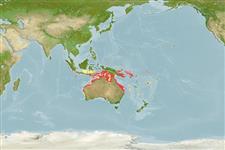
Western Pacific: southern New Guinea, Solomon Islands, and northern Australia (including Western Australia, Ref. 7300).
Longitud en la primera madurez / Tamaño / Peso / Edad
Madurez: Lm 91.0, range 85 - ? cm
Max length : 150 cm TL macho / no sexado; (Ref. 244); 150.0 cm TL (female)
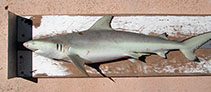
Espinas dorsales (total) : 0; Espinas anales: 0. Grey or light brown above, white below; dorsal, caudal, and pectoral fins with black margins, expanded apically to black tips on caudal fin lobes and pectoral fins; probably a conspicuous white band on flank (Ref. 9997).
Body shape (shape guide): fusiform / normal.
A little-known reef shark found in shallow water on the continental and insular shelves, but may range in deeper water (Ref. 244). Feeds on small fishes and crabs (Ref. 244). Viviparous (Ref. 50449). Rather skittish and timid when approached (Ref. 244). Probably harmless or minimally hazardous to people (Ref. 244). Utilized for human consumption (Ref. 9997).
Viviparous, placental (Ref. 50449). Size at birth between 35 and 39 cm (Ref. 244). Distinct pairing with embrace (Ref. 205).
Compagno, L.J.V., 1984. FAO Species Catalogue. Vol. 4. Sharks of the world. An annotated and illustrated catalogue of shark species known to date. Part 2 - Carcharhiniformes. FAO Fish. Synop. 125(4/2):251-655. Rome: FAO. (Ref. 244)
Situación en la Lista Roja de la UICN (Ref. 130435: Version 2025-2 (Global))
Amenaza para el ser humano
Usos humanos
Pesquerías: escaso valor comercial
Herramientas
Informes especiales
Descargar XML
Fuentes de Internet
Estimaciones basadas en modelos
Temperatura preferida (Referencia
123201): 24.3 - 28.6, mean 27.5 °C (based on 348 cells).
Índice de diversidad filogenética (Referencia
82804): PD
50 = 0.5000 [Uniqueness, from 0.5 = low to 2.0 = high].
Bayesian length-weight: a=0.00347 (0.00194 - 0.00621), b=3.08 (2.93 - 3.23), in cm total length, based on LWR estimates for this species & Genus-body shape (Ref.
93245).
Nivel trófico (Referencia
69278): 4.3 ±0.3 se; based on diet studies.
Resiliencia (Referencia
120179): Muy bajo, población duplicada en un tiempo mínimo superior a 14 años (Fec = 1).
Vulnerabilidad pesquera (Ref.
59153): Very high vulnerability (90 of 100).
🛈
Nutrientes (Ref.
124155): Calcium = 7.5 [1.5, 38.8] mg/100g; Iron = 0.403 [0.105, 1.136] mg/100g; Protein = 22.1 [19.2, 24.3] %; Omega3 = 0.126 [0.054, 0.289] g/100g; Selenium = 39.7 [10.8, 103.3] μg/100g; VitaminA = 58.3 [23.7, 151.7] μg/100g; Zinc = 0.556 [0.267, 1.076] mg/100g (wet weight);