Élasmobranches (requins et raies) (sharks and rays) >
Carcharhiniformes (Ground sharks) >
Carcharhinidae (Requiem sharks)
Etymology: Carcharhinus: karcharos (Gr.), sharp or jagged; rhinus, an ancient name for sharks, from rhine (Gr.), rasp, both words alluding to a shark's jagged, rasp-like skin (See ETYFish); brachyurus: brachys (Gr.), short; oura (Gr.), tail, a probable misnomer since caudal fin is not short (¼ TL) and type specimens were described from mounted skins and embryos (some sources indicate name means “short-bodied”) (See ETYFish).
More on author: Günther.
Taxonomic Remarks
Carcharhinus acarenatus Moreno & Hoyos, 1983 may be a valid species. See ECoF.
Environnement : milieu / zone climatique / profondeur / gamme de distribution
Écologie
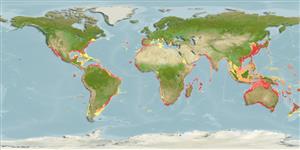
marin; saumâtre récifal; océanodrome (Ref. 51243); profondeur 0 - 360 m (Ref. 58018). Subtropical; 45°N - 52°S, 122°W - 180°E
Western Atlantic: Mexico, Gulf of Mexico, Brazil to Argentina. Eastern Atlantic: off France southward and around the coast of southern Africa to central Natal, South Africa (Ref. 5578), including the Mediterranean. Possibly two separate populations in southern Africa (Ref. 3209). Western Pacific: Japan to New Zealand. Eastern Pacific: southern California, USA to the Gulf of California in Mexico and Peru.
Longueur à la première maturité / Taille / Poids / Âge
Maturité: Lm 230.0, range 245 - 240 cm
Max length : 325 cm TL mâle / non sexé; (Ref. 2334); poids max. publié: 304.6 kg (Ref. 40637); âge max. reporté: 30 années (Ref. 3209)
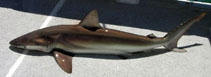
Épines dorsales (Total) : 0; Épines anales: 0. A large shark to with a bluntly pointed, broad snout, narrow, bent cusps on the upper teeth, and with no interdorsal ridge (Ref. 5578). Grey to bronzy in color, white below (Ref. 5578); fins mostly plain except for dusky tips on pelvic fins, as well as dusky to black tips and rear edges on pectoral fins (Ref. 9997).
Body shape (shape guide): fusiform / normal.
A coastal and offshore shark (Ref. 9997) found along continental margins in most tropical and temperate seas. Occasionally enters large coastal bays and inshore areas (Ref. 6390). Occasionally found near the bottom (Ref. 6808). Migratory in the northern part of its range, moving northward in spring and summer and southward in autumn and winter (Ref. 244). Feeds on pelagic and bottom bony fishes, cephalopods, and small sharks and rays (Ref. 5578). Viviparous (Ref. 50449). Undoubtedly utilized for human consumption where it occurs (Ref. 244). Implicated in shark attacks on people (Ref. 9997).
Cycle de vie et comportement reproducteur
Maturité | Reproduction | Frai | Œufs | Fécondité | Larves
Viviparous, with a yolk-sac placenta. Litter contains 7 to 20 pups (Ref. 6871, 6390). Young born at 59 - 70 cm TL (Ref. 6390). Pupping may occur at any time of the year but there is a peak in births in summer (Ref. 6390). Distinct pairing with embrace (Ref. 205).
Compagno, L.J.V., 1984. FAO Species Catalogue. Vol. 4. Sharks of the world. An annotated and illustrated catalogue of shark species known to date. Part 2 - Carcharhiniformes. FAO Fish. Synop. 125(4/2):251-655. Rome: FAO. (Ref. 244)
Statut dans la liste rouge de l'IUCN (Ref. 130435: Version 2025-2 (Global))
Menace pour l'homme
Traumatogenic (Ref. 4690)
Utilisations par l'homme
Pêcheries: intérêt commercial mineur; pêche sportive: oui
Outils
Articles particuliers
Télécharger en XML
Sources Internet
Estimations basées sur des modèles
Température préférée (Réf.
123201): 11.6 - 23.8, mean 17.4 °C (based on 797 cells).
Indice de diversité phylogénétique (Réf.
82804): PD
50 = 0.5000 [Uniqueness, from 0.5 = low to 2.0 = high].
Bayesian length-weight: a=0.00501 (0.00250 - 0.01004), b=3.07 (2.91 - 3.23), in cm total length, based on LWR estimates for this species & Genus-body shape (Ref.
93245).
Niveau trophique (Réf.
69278): 4.5 ±0.0 se; based on diet studies.
Generation time: 28.9 ( na - na) years. Estimated as median ln(3)/K based on 1
growth studies.
Résilience (Réf.
120179): Très faible, temps minimum de doublement de population supérieur à 14 ans (K=0.04; tm=5-20; tmax=30; Fec=7).
Vulnérabilité de la pêche (Ref.
59153): Very high vulnerability (87 of 100).
🛈
Vulnérabilité climatique (Ref.
125649): High vulnerability (57 of 100).
🛈
Nutriments (Ref.
124155): Calcium = 2.54 [0.47, 14.40] mg/100g; Iron = 0.3 [0.1, 0.9] mg/100g; Protein = 23 [20, 25] %; Omega3 = 0.172 [0.060, 0.438] g/100g; Selenium = 19.4 [5.6, 61.2] μg/100g; VitaminA = 30.3 [7.9, 119.7] μg/100g; Zinc = 0.413 [0.195, 0.829] mg/100g (wet weight);