Ambiente: milieu / zona climatica / distribuzione batimetrica / gamma di distribuzione
Ecologia
marino associati a barriera corallina; non migratori (Ref. 52884); distribuzione batimetrica 0 - 20 m (Ref. 93839). Tropical
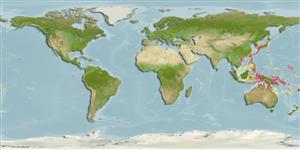
Western Pacific: southern Japan south to the Coral Sea.
Dimensione / Peso / Età
Maturità: Lm ? range ? - ? cm
Max length : 10.0 cm TL maschio/sesso non determinato; (Ref. 2334); common length : 8.0 cm SL maschio/sesso non determinato; (Ref. 37816)
Breve descrizione
Chiavi di identificazione | Morfologia | Morfometria
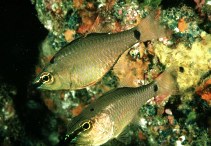
Spine dorsali (totale) : 8; Raggi dorsali molli (totale) : 9; Spine anali: 2; Raggi anali molli: 8. Characterized by having a black band from the snout to the eye; distinct spot on nape; black spot on caudal fin base; black blotch on the first dorsal fin distally; blackish bands along the bases of the second dorsal and anal fins (Ref. 93839).
Body shape (shape guide): short and / or deep; Cross section: compressed.
Occur in groups around coral bommies (Ref. 2334). In Japan, the breeding season is from June to September. Breeding pairs set up territory which is mostly defended by the female (Ref. 57690). Mouthbrooding is done by the male parents (Ref. 559 and 637) some of which resort to partial egg cannibalism probably to adjust the brood size to their buccal capacity (Ref. 57690). Nocturnal species, but courtship and spawning takes place during day (Ref. 7300, 37227, 38747).
Clutches of eggs from a single female are mouthbrooded by males (Ref. 57684). Distinct pairing (obligate monogamy) during courtship and spawning (Ref. 205, 52884). Multiple spawner with 10-19 days interval between matings (Ref. 38747). Females attack conspecifics during courtship (Ref. 57684). The operational sex ratio is male biased all throughout the breeding season primarily due to a higher mortality in females, thus sex-role reversal is not predicted for this species (Ref. 57684).
Randall, J.E., G.R. Allen and R.C. Steene, 1990. Fishes of the Great Barrier Reef and Coral Sea. University of Hawaii Press, Honolulu, Hawaii. 506 p. (Ref. 2334)
Stato della Lista Rossa IUCN (Ref. 130435: Version 2025-2 (Global))
Minaccia per l'uomo
Harmless
Usi umani
Strumenti
Rapporti speciali
Scarica XML
Fonti Internet
Stime basate su modelli
Temperatura preferita (Fonte Biblio.
123201): 21.5 - 29.3, mean 28.4 °C (based on 1585 cells).
Indice di diversità filogenetica (Fonte Biblio.
82804): PD
50 = 0.5000 [Uniqueness, from 0.5 = low to 2.0 = high].
Bayesian length-weight: a=0.01318 (0.00580 - 0.02997), b=3.10 (2.92 - 3.28), in cm total length, based on LWR estimates for this Genus-body shape (Ref.
93245).
Livello trofico (Fonte Biblio.
69278): 3.5 ±0.50 se; based on food items.
Resilienza (Fonte Biblio.
120179): Medio, tempo minimo di raddoppiamento della popolazione 1.4 - 4.4 anni (Fec=3,315).
Vulnerabilità della pesca (Ref.
59153): Low vulnerability (10 of 100).
🛈
Nutrienti (Ref.
124155): Calcium = 148 [73, 243] mg/100g; Iron = 0.996 [0.568, 1.740] mg/100g; Protein = 18.6 [17.4, 19.8] %; Omega3 = 0.123 [0.068, 0.217] g/100g; Selenium = 29.4 [14.9, 58.0] μg/100g; VitaminA = 57.6 [16.8, 200.3] μg/100g; Zinc = 1.76 [1.14, 2.64] mg/100g (wet weight);