Elasmobranchi (squali e razze) (sharks and rays) >
Carcharhiniformes (Ground sharks) >
Carcharhinidae (Requiem sharks)
Etymology: Carcharhinus: karcharos (Gr.), sharp or jagged; rhinus, an ancient name for sharks, from rhine (Gr.), rasp, both words alluding to a shark's jagged, rasp-like skin (See ETYFish); altimus: Latin for highest, allusion not explained nor evident (See ETYFish).
Ambiente: milieu / zona climatica / distribuzione batimetrica / gamma di distribuzione
Ecologia
marino associati a barriera corallina; distribuzione batimetrica 12 - 810 m (Ref. 58302), usually 80 - 220 m (Ref. 9253). Subtropical; 46°N - 31°S, 180°W - 180°E
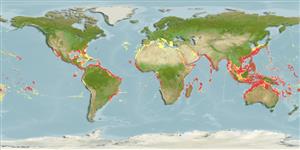
Circumglobal: tropical to temperate watersin the Atlantic, Pacific and Indian oceans. Introduced in the Mediterranean via Gibralltar.
Lunghezza alla prima maturità / Dimensione / Peso / Età
Maturità: Lm 230.0, range 205 - 282 cm
Max length : 300 cm TL maschio/sesso non determinato; (Ref. 2334); common length : 250 cm TL maschio/sesso non determinato; (Ref. 26999); peso massimo pubblicato: 167.8 kg (Ref. 40637)
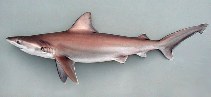
Spine dorsali (totale) : 0; Spine anali: 0. A heavily-bodied, cylindrical shark with a large, long and broad snout, long nasal flaps and high, triangular, saw-edged upper teeth; interdorsal ridge high and prominent; pectoral and dorsal fins large and straight (Ref. 5578). Grayish with no conspicuous markings, white below (Ref. 5578); inner corners of pectoral fins blackish (Ref. 9997).
Body shape (shape guide): fusiform / normal.
Found near the edge of the continental and insular shelves and uppermost slopes (Ref. 244). Rare in shallow waters (Ref. 9997), bottom associated near shelf breaks and drop-offs; young may occur at 25 m (Ref. 58302). Feeds on bony fishes, other sharks, stingrays, and cuttlefish (Ref. 244). Viviparous (Ref. 50449). Utilized for fishmeal, liver oil, and shagreen (Ref. 9997). Minimum depth reported taken from Ref. 244.
Viviparous, placental (Ref. 50449). Gives birth every second year with 1-13 (average 9) pups per litter (Ref. 58048). In the Mediterranean, sharks give birth in August and September, however in Madagascar, young are born in September and October (Ref. 244). Size at birth 60-75 cm (Ref. 6871); 70-90 cm TL (Ref.58048). Distinct pairing with embrace (Ref. 205).
Compagno, L.J.V., 1984. FAO Species Catalogue. Vol. 4. Sharks of the world. An annotated and illustrated catalogue of shark species known to date. Part 2 - Carcharhiniformes. FAO Fish. Synop. 125(4/2):251-655. Rome: FAO. (Ref. 244)
Stato della Lista Rossa IUCN (Ref. 130435: Version 2025-2 (Global))
Usi umani
Pesca: scarso interesse commerciale; Pesce da pesca sportiva: si
Strumenti
Rapporti speciali
Scarica XML
Fonti Internet
Stime basate su modelli
Temperatura preferita (Fonte Biblio.
123201): 13.8 - 26.5, mean 19.9 °C (based on 875 cells).
Indice di diversità filogenetica (Fonte Biblio.
82804): PD
50 = 0.5000 [Uniqueness, from 0.5 = low to 2.0 = high].
Bayesian length-weight: a=0.00372 (0.00223 - 0.00619), b=3.08 (2.94 - 3.22), in cm total length, based on LWR estimates for this species & Genus-body shape (Ref.
93245).
Livello trofico (Fonte Biblio.
69278): 4.5 ±0.3 se; based on diet studies.
Resilienza (Fonte Biblio.
120179): Molto basso, tempo minimo di raddoppiamento della popolazione più di 14 anni (Fec=1-13;).
Vulnerabilità della pesca (Ref.
59153): Very high vulnerability (90 of 100).
🛈
Nutrienti (Ref.
124155): Calcium = 2.96 [0.55, 15.71] mg/100g; Iron = 0.338 [0.086, 0.978] mg/100g; Protein = 22.9 [20.0, 25.1] %; Omega3 = 0.186 [0.069, 0.461] g/100g; Selenium = 24 [8, 71] μg/100g; VitaminA = 26.4 [9.0, 79.0] μg/100g; Zinc = 0.305 [0.149, 0.601] mg/100g (wet weight);