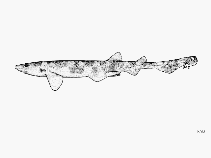
Élasmobranches (requins et raies) (sharks and rays) >
Carcharhiniformes (Ground sharks) >
Scyliorhinidae (Cat sharks) > Scyliorhininae
Etymology: Scyliorhinus: skylion, Greek for dogfish or small shark; rhinus, from rhine (Gr.), rasp, alluding to a shark’s jagged, rasp-like skin (See ETYFish); torazame: Japanese vernacular, meaning “tiger shark,” referring to its markings (See ETYFish).
More on author: Tanaka.
Environnement : milieu / zone climatique / profondeur / gamme de distribution
Écologie
marin démersal; profondeur 0 - 300 m (Ref. 125694). Tropical; 44°N - 22°N, 120°E - 147°E (Ref. 120402)
Northwest Pacific: Japan, Korea and Taiwan.
Longueur à la première maturité / Taille / Poids / Âge
Maturité: Lm 39.5, range 37 - 42 cm
Max length : 77.8 cm TL mâle / non sexé; (Ref. 120402); 47.8 cm TL (female)
Épines dorsales (Total) : 0; Épines anales: 0. This species is distinguished from all its congeners by having specialized hooks in the clasper (vs. absent); pelvic apron extends almost entirely the length of pelvic inner margins (vs. up to 2/3 length of pelvic inner margins in S. boa, S. cabofriensis, S. cervigoni, S. comoroensis, S. haeckelii, S. hesperius, S. meadi, S. retifer, S. stellaris, S. ugoi); males with distal tips of pelvic fins straight (vs. tapered); body beige to light brown with cream to beige spots (vs. no light spots in S. cervigoni, S. garmani, S. meadi, S. retifer and yellow to golden spots in S. capensis), and spots are predominantly spiracle-sized (vs. mostly smaller than spiracles in S. boa, S. cabofriensis, S. canicula, S. duhamelii, S. stellaris, S. ugoi). Other characters, although less distinct, that also helps distinguish this species are the following: saddles darker than the background color (vs. inconspicuous in S. boa, S. cabofriensis, S. cervigoni, S. garmani, S. torrei); anterior nasal flaps not reaching the upper lip (vs. reaching upper lip, and sometimes covering it, in S. canicula, S. cervigoni, comoroensis, S. duhamelii, S. garmani, S. stellaris); interdorsal distance 0.6-1.0 times smaller than anal base (vs. greater than anal base in S. boa, S. cabofriensis, S. haeckelii, S. hesperius, S. meadi, S. retifer, S. torrei, S. ugoi); mandibular canal of lateral line system with 5-6 pores (vs. 3-4 in S. hesperius); oral canal of lateral line system with 7-10 pores (vs.10-12 in S. duhamelii; 5-6 in S. hesperius; 9-13 in S. torrei); commissural teeth with one cusplet and principal cusplet laterally situated (vs. 2 or more in other species, except in S. cervigoni, S. meadi, S. torrei); clasper with terminal dermal cover smooth (vs. rough in S. canicula, S. capensis); cover rhipidion covered by dermal denticles (vs. not covered in S. boa, S. cervigoni, S. retifer); terminal 3 cartilage present (vs. absent in S. cabofriensis, S. cervigoni, S. comoroensis, S. duhamelii, S. haeckelii, S. stellaris, S. torrei, S. ugoi); dorsal terminal 2 cartilage elongated and similar in size to dorsal terminal cartilage (vs. reduced and subtriangular in S. cabofriensis, S. capensis, S. cervigoni, S. haeckelii, S. ugoi; dorsal terminal 2 less than half length of dorsal terminal cartilage in S. boa, S. canicula, S. duhamelii, S. retifer, S. stellaris, S. torrei); counts of monospondylous vertebrae 32-37 (vs. lower in other species, except in S. canicula, S. duhamelii, S. haeckelii, S. torrei); adult males between 36.0-40.0 cm TL and adult females between 37.0-42.0 cm TL (vs. adult reach greater sizes at sexual maturity in S. capensis, S. cervigoni, S. meadi, S. stellaris, S. ugoi) (Ref. 120402).
Body shape (shape guide): elongated; Cross section: circular.
A common catshark found on the continental shelf, from close inshore down to at least 100 m (Ref. 244, 11230); with records from the Tsushima Strait at 120 m and Korea Strait at 140 m depth; also known to enter shallow coastal waters (Ref. 120402). Oviparous (Ref. 50449). Adult males are between 36.0-40.0 cm TL (largest reported 77.8 cm TL) while adult female sizes at 37.0-42.0 cm TL (largest 47.8 cm TL). Egg capsules are translucent yellow with smooth surface, with anterior tip slightly concave and posterior tip truncate, with long tendrils (mean values for egg capsule dimensions: 5.5 cm length. 1.9 cm width, n = 3) (Ref. 120402). Interest to fisheries unknown (Ref. 11146).
Cycle de vie et comportement reproducteur
Maturité | Reproduction | Frai | Œufs | Fécondité | Larves
Oviparous, with only one egg laid per oviduct at a time (Ref. 244). Embryos feed solely on yolk (Ref. 50449). Size at hatching at least 8 cm (Ref. 244).
During courtship and prior to copulation, the male bites and wraps the female's pectoral fin, body, tail, and gills (Ref. 49562, 51119). Copulation is initiated when the male inserts one of its claspers into the female's cloaca. The whole mating episode lasts from 15 seconds to 4 minutes (Ref. 49562).
Soares, K.D.A. and M.R. De Carvalho, 2019. The catshark genus Scyliorhinus (Chondrichthyes: Carcharhiniformes: Scyliorhinidae): taxonomy, morphology and distribution. Zootaxa 4601(1):1-147. (Ref. 120402)
Statut dans la liste rouge de l'IUCN (Ref. 130435: Version 2025-2 (Global))
Menace pour l'homme
Harmless
Utilisations par l'homme
Outils
Articles particuliers
Télécharger en XML
Sources Internet
Estimations basées sur des modèles
Indice de diversité phylogénétique (Réf.
82804): PD
50 = 0.5000 [Uniqueness, from 0.5 = low to 2.0 = high].
Bayesian length-weight: a=0.00269 (0.00140 - 0.00518), b=3.21 (3.04 - 3.38), in cm total length, based on LWR estimates for this (Sub)family-body shape (Ref.
93245).
Niveau trophique (Réf.
69278): 3.9 ±0.61 se; based on food items.
Résilience (Réf.
120179): Très faible, temps minimum de doublement de population supérieur à 14 ans (Fec = 1).
Vulnérabilité de la pêche (Ref.
59153): Moderate to high vulnerability (51 of 100).
🛈