>
Scombriformes (Mackerels) >
Trichiuridae (Cutlassfishes) > Aphanopodinae
Etymology: Aphanopus: Greek, aphanes = hidden + Greek, pous = foot (Ref. 45335).
Environnement : milieu / zone climatique / profondeur / gamme de distribution
Écologie
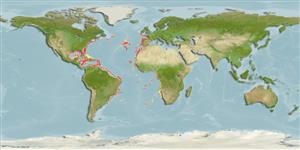
marin benthopélagique; profondeur 300 - 1408 m (Ref. 6181). Deep-water; 50°N - 35°S, 105°E - 14°E (Ref. 6181)
Atlantic Ocean: in moderately warm and tropical waters; it has not been found only off the coast of South America. In the eastern Atlantic, it is found off western Sahara, Congo and Angola, from Sierra Leone submarine rise and Pilberry Seamount (Ref. 10818).
Taille / Poids / Âge
Maturité: Lm ? range ? - ? cm
Max length : 148 cm TL mâle / non sexé; (Ref. 108735)
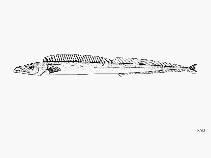
Épines dorsales (Total) : 39 - 44; Rayons mous dorsaux (Total) : 54 - 59; Épines anales: 2; Rayons mous anaux: 46 - 50; Vertèbres: 102 - 108. Pelvic fins represented by a single spine in juveniles inserted before the base of the pectoral fins but entirely absent in adults. Body is coppery black with iridescent tint. The inside of the mouth and gill cavities black.
Body shape (shape guide): eel-like; Cross section: compressed.
Adults benthopelagic from 800 to 1,350 m, juveniles mesopelagic from 300 to 500 m (Ref. 6181). Up until recently, fisheries catch landings of A. carbo, a sympatric species in the waters of Canary and Madeira islands, were mixed with A. intemedius.
Cycle de vie et comportement reproducteur
Maturité | Reproduction | Frai | Œufs | Fécondité | Larves
Displays determinate fecundity (Ref. 108695). Mature individuals undertake horizontal migration to spawning and nursery grounds (Ref. 108708).
Nakamura, I. and N.V. Parin, 1993. FAO Species Catalogue. Vol. 15. Snake mackerels and cutlassfishes of the world (families Gempylidae and Trichiuridae). An annotated and illustrated catalogue of the snake mackerels, snoeks, escolars, gemfishes, sackfishes, domine, oilfish, cutlassfishes,. scabbardfishes, hairtails, and frostfishes known to date. FAO Fish. Synop. 125(15):136 p. (Ref. 6181)
Statut dans la liste rouge de l'IUCN (Ref. 130435: Version 2025-2 (Global))
Menace pour l'homme
Harmless
Utilisations par l'homme
Pêcheries: commercial
Outils
Articles particuliers
Télécharger en XML
Sources Internet
Estimations basées sur des modèles
Température préférée (Réf.
123201): 6.2 - 13.7, mean 9.4 °C (based on 190 cells).
Indice de diversité phylogénétique (Réf.
82804): PD
50 = 0.5078 [Uniqueness, from 0.5 = low to 2.0 = high].
Bayesian length-weight: a=0.00110 (0.00060 - 0.00201), b=3.08 (2.91 - 3.25), in cm total length, based on LWR estimates for this species & (Sub)family-body (Ref.
93245).
Niveau trophique (Réf.
69278): 4.3 ±0.7 se; based on size and trophs of closest relatives
Résilience (Réf.
120179): Faible, temps minimum de doublement de population : 4,5 à 14 années (K=0.121; tmax=15).
Vulnérabilité de la pêche (Ref.
59153): High vulnerability (62 of 100).
🛈
Vulnérabilité climatique (Ref.
125649): Moderate vulnerability (42 of 100).
🛈
Nutriments (Ref.
124155): Calcium = 7.2 [3.4, 23.3] mg/100g; Iron = 0.204 [0.058, 0.575] mg/100g; Protein = 15.8 [14.1, 17.6] %; Omega3 = 0.277 [0.112, 0.714] g/100g; Selenium = 42.9 [11.2, 142.5] μg/100g; VitaminA = 11.3 [2.0, 59.4] μg/100g; Zinc = 0.373 [0.178, 0.733] mg/100g (wet weight);