>
Eupercaria/misc (Various families in series Eupercaria) >
Sillaginidae (Smelt-whitings)
Etymology: Sillago: From a locality in Australia.
Eponymy: Hugo Frederik Nierstrasz (1872–1937) was a Dutch marine biologist. [...] (Ref. 128868), visit book page.
Entorno: milieu / zona climática / rango de profundidad / gama de distribución
Ecología
marino demersal; no migratorio. Tropical; 1°S - 13°S, 129°E - 152°E (Ref. 6205)
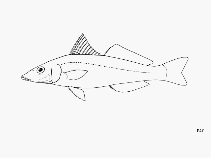
Western Central Pacific: southern New Guinea. Known only from the holotype which could not be located. In most features, this species is similar to Sillago analis and may prove to be a senior synonym. Further collection is necessary to resolve the identity of this species.
Tamaño / Peso / Edad
Madurez: Lm ? range ? - ? cm
Max length : 25.0 cm TL macho / no sexado; (Ref. 6205)
Descripción breve
Claves de identificación | Morfología | Morfometría
Espinas dorsales (total) : 12; Radios blandos dorsales (total) : 17; Espinas anales: 2; Radios blandos anales: 17.
Body shape (shape guide): elongated; Cross section: circular.
Occur in inshore benthic areas (Ref. 6205). Oviparous (Ref. 205).
Ciclo vital y comportamiento de apareamiento
Madurez | Reproducción | Puesta | Huevos | Fecundidad | Larva
McKay, R.J., 1992. FAO Species Catalogue. Vol. 14. Sillaginid fishes of the world (family Sillaginidae). An annotated and illustrated catalogue of the sillago, smelt or Indo-Pacific whiting species known to date. Rome: FAO. FAO Fish. Synop. 125(14):87p. (Ref. 6205)
Situación en la Lista Roja de la UICN (Ref. 130435: Version 2025-2 (Global))
Amenaza para el ser humano
Harmless
Usos humanos
Pesquerías: sin interés
Herramientas
Informes especiales
Descargar XML
Fuentes de Internet
Estimaciones basadas en modelos
Índice de diversidad filogenética (Referencia
82804): PD
50 = 0.5000 [Uniqueness, from 0.5 = low to 2.0 = high].
Bayesian length-weight: a=0.00575 (0.00270 - 0.01228), b=3.06 (2.89 - 3.23), in cm total length, based on LWR estimates for this Genus-body shape (Ref.
93245).
Nivel trófico (Referencia
69278): 3.3 ±0.4 se; based on size and trophs of closest relatives
Resiliencia (Referencia
120179): Alto, población duplicada en un tiempo mínimo inferior a 15 meses (Preliminary K or Fecundity.).
Vulnerabilidad pesquera (Ref.
59153): Low vulnerability (15 of 100).
🛈