Environnement : milieu / zone climatique / profondeur / gamme de distribution
Écologie
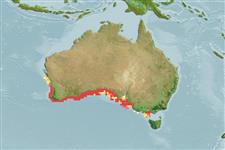
marin démersal; océanodrome (Ref. 51243); profondeur 1 - 60 m (Ref. 9563). Temperate; 28°S - 40°S, 112°E - 145°E (Ref. 6205)
Eastern Indian Ocean: Endemic to southern regions of the Australian continental shelf. Distribution ranges from Kangaroo Island in South Australia (Ref. 27573) to Geraldton in Western Australia (Ref. 6335). Report from Western Victoria (Ref. 6205) is erroneous (Ref. 6390). Not yet recorded from western Tasmania.
Longueur à la première maturité / Taille / Poids / Âge
Maturité: Lm 20.0 range ? - ? cm
Max length : 33.0 cm SL mâle / non sexé; (Ref. 6205)
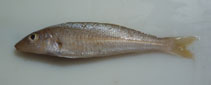
Épines dorsales (Total) : 11 - 13; Rayons mous dorsaux (Total) : 18 - 19; Épines anales: 2; Rayons mous anaux: 18 - 20; Vertèbres: 33 - 35. No dark spot at the base of the pectoral fin; a series of oblique broken rusty brown bars on the back and upper sides, without a longitudinal row of rusty brown blotches along the midlateral silver stripe.
Body shape (shape guide): fusiform / normal; Cross section: circular.
Live close to the sea bed over sandy substrates. Occur in the surf zone of beaches and quiet waters of bays and sandbanks. Are trawled in offshore waters to at least 55 m and possibly deeper. Juveniles may be found in shallow water off white sand beaches, together with accumulations of dead seaweed in the surf zone during spring and summer in Western Australia. Move into shallow waters in large schools during full moon (Ref. 6205). Feed mainly on crustaceans, amphipods, decapods, mysids and copepods. Juveniles consume mostly copepods (Ref. 6223). Oviparous (Ref. 205), and are multiple spawners with asynchronous development (Ref. 12343).
Cycle de vie et comportement reproducteur
Maturité | Reproduction | Frai | Œufs | Fécondité | Larves
S. bassensis is a multiple spawner and spawns asynchronously during the breeding season (Ref. 12343).
McKay, R.J., 1992. FAO Species Catalogue. Vol. 14. Sillaginid fishes of the world (family Sillaginidae). An annotated and illustrated catalogue of the sillago, smelt or Indo-Pacific whiting species known to date. Rome: FAO. FAO Fish. Synop. 125(14):87p. (Ref. 6205)
Statut dans la liste rouge de l'IUCN (Ref. 130435: Version 2025-2 (Global))
Menace pour l'homme
Harmless
Utilisations par l'homme
Pêcheries: intérêt commercial mineur; pêche sportive: oui
Outils
Articles particuliers
Télécharger en XML
Sources Internet
Estimations basées sur des modèles
Température préférée (Réf.
123201): 15.2 - 20.5, mean 17.8 °C (based on 100 cells).
Indice de diversité phylogénétique (Réf.
82804): PD
50 = 0.5000 [Uniqueness, from 0.5 = low to 2.0 = high].
Bayesian length-weight: a=0.00851 (0.00363 - 0.01997), b=3.08 (2.87 - 3.29), in cm total length, based on LWR estimates for this (Sub)family-body shape (Ref.
93245).
Niveau trophique (Réf.
69278): 3.3 ±0.47 se; based on food items.
Generation time: 4.2 ( na - na) years. Estimated as median ln(3)/K based on 2
growth studies.
Résilience (Réf.
120179): Milieu, temps minimum de doublement de population : 1,4 à 4,4 années (K=0.26-0.29).
Vulnérabilité de la pêche (Ref.
59153): Moderate vulnerability (37 of 100).
🛈