>
Scombriformes (Mackerels) >
Gempylidae (Snake mackerels)
Etymology: Rexichthys: Latin, rex, rego = king + Greek, ichthys = fish; johnpaxtoni: Named in honor of John R. Paxton, curator of the collection of fishes of the Australian Museum in Sydney (Ref. 44066).
Eponymy: Dr John Richard Paxton (d: 1938) is an American-born Australian ichthyologist. [...] (Ref. 128868), visit book page.
Environnement : milieu / zone climatique / profondeur / gamme de distribution
Écologie
marin benthopélagique; profondeur 270 - 470 m (Ref. 9784). Deep-water; 17°S - 35°S, 140°E - 170°W (Ref. 6181)
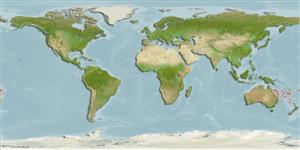
Western Pacific: eastern coast of Australia between 17°31'S and 32°34'S, and from New Caledonia.
Taille / Poids / Âge
Maturité: Lm ? range ? - ? cm
Max length : 22.0 cm SL mâle / non sexé; (Ref. 6181)
Épines dorsales (Total) : 19; Rayons mous dorsaux (Total) : 14 - 15; Épines anales: 2; Rayons mous anaux: 12 - 13; Vertèbres: 34. Body moderately elongate and compressed. Two lateral lines, the lower originating below the 6th to the 7th spine of the first dorsal fin, descending sharply to ventral contour of body, dividing into a short anterior branch and a much longer posterior branch. The pelvic fin represented by 1 spine and 2 tiny soft rays in smaller specimens but entirely absent in specimens over 10 cm SL. Body color is brownish, fins hyaline; first dorsal fin with a black blotch distally on two anterior membranes.
Body shape (shape guide): elongated; Cross section: compressed.
Adults are probably benthopelagic from 400 to 470 m while juveniles are pelagic from 270 to 400 m depth.
Cycle de vie et comportement reproducteur
Maturité | Reproduction | Frai | Œufs | Fécondité | Larves
Nakamura, I. and N.V. Parin, 1993. FAO Species Catalogue. Vol. 15. Snake mackerels and cutlassfishes of the world (families Gempylidae and Trichiuridae). An annotated and illustrated catalogue of the snake mackerels, snoeks, escolars, gemfishes, sackfishes, domine, oilfish, cutlassfishes,. scabbardfishes, hairtails, and frostfishes known to date. FAO Fish. Synop. 125(15):136 p. (Ref. 6181)
Statut dans la liste rouge de l'IUCN (Ref. 130435: Version 2025-2 (Global))
Menace pour l'homme
Harmless
Utilisations par l'homme
Outils
Articles particuliers
Télécharger en XML
Sources Internet
Estimations basées sur des modèles
Température préférée (Réf.
123201): 13.8 - 17.6, mean 17.2 °C (based on 13 cells).
Indice de diversité phylogénétique (Réf.
82804): PD
50 = 1.0000 [Uniqueness, from 0.5 = low to 2.0 = high].
Bayesian length-weight: a=0.00372 (0.00169 - 0.00815), b=3.11 (2.92 - 3.30), in cm total length, based on LWR estimates for this (Sub)family-body shape (Ref.
93245).
Niveau trophique (Réf.
69278): 3.8 ±0.5 se; based on size and trophs of closest relatives
Résilience (Réf.
120179): Milieu, temps minimum de doublement de population : 1,4 à 4,4 années (Assuming tmax>3).
Vulnérabilité de la pêche (Ref.
59153): Low vulnerability (17 of 100).
🛈