>
Scombriformes (Mackerels) >
Gempylidae (Snake mackerels)
Etymology: Neoepinnula: Greek, neos = new + Latin ex = outside + Latin, diminutive of pinna = spiny (Ref. 45335).
Entorno: milieu / zona climática / rango de profundidad / gama de distribución
Ecología
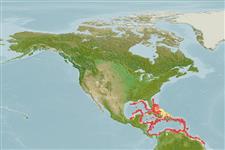
marino bentopelágico; rango de profundidad 184 - 457 m (Ref. 6181). Deep-water; 31°N - 3°N, 94°W - 49°W (Ref. 6181)
Western Atlantic: known only from the Gulf of Mexico, Yucatán Channel, Caribbean Sea off Venezuela, off Suriname, and off southern Brazil (Ref. 47377).
Tamaño / Peso / Edad
Madurez: Lm ? range ? - ? cm
Max length : 22.0 cm SL macho / no sexado; (Ref. 6181)
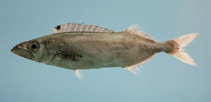
Espinas dorsales (total) : 27; Radios blandos dorsales (total) : 17 - 20; Espinas anales: 3; Radios blandos anales: 17 - 20. There are two lateral lines on the sides, both originating above the upper angle of the gill opening. Sometimes the lower lateral line branches off from the second or third tubular scale of the upper lateral line. The sides are silvery, the back brown; the first dorsal fin is blackish, the second dorsal fin black anteriorly; the buccal cavity is pale, and the branchial cavity pale to dusky.
Body shape (shape guide): fusiform / normal; Cross section: oval.
Ciclo vital y comportamiento de apareamiento
Madurez | Reproducción | Puesta | Huevos | Fecundidad | Larva
Nakamura, I. and N.V. Parin, 1993. FAO Species Catalogue. Vol. 15. Snake mackerels and cutlassfishes of the world (families Gempylidae and Trichiuridae). An annotated and illustrated catalogue of the snake mackerels, snoeks, escolars, gemfishes, sackfishes, domine, oilfish, cutlassfishes,. scabbardfishes, hairtails, and frostfishes known to date. FAO Fish. Synop. 125(15):136 p. (Ref. 6181)
Situación en la Lista Roja de la UICN (Ref. 130435: Version 2025-2 (Global))
Amenaza para el ser humano
Harmless
Usos humanos
Herramientas
Informes especiales
Descargar XML
Fuentes de Internet
Estimaciones basadas en modelos
Temperatura preferida (Referencia
123201): 9.9 - 19.6, mean 16 °C (based on 46 cells).
Índice de diversidad filogenética (Referencia
82804): PD
50 = 0.6250 [Uniqueness, from 0.5 = low to 2.0 = high].
Bayesian length-weight: a=0.01023 (0.00424 - 0.02467), b=3.00 (2.79 - 3.21), in cm total length, based on LWR estimates for this (Sub)family-body shape (Ref.
93245).
Nivel trófico (Referencia
69278): 3.8 ±0.5 se; based on size and trophs of closest relatives
Resiliencia (Referencia
120179): Alto, población duplicada en un tiempo mínimo inferior a 15 meses (Preliminary K or Fecundity.).
Vulnerabilidad pesquera (Ref.
59153): Low vulnerability (17 of 100).
🛈