>
Gadiformes (Cods) >
Macrouridae (Grenadiers or rattails)
Etymology: Coelorinchus: Greek, koilos = a hollow + Greek, rhyngchos = jaw (Ref. 45335); kaiyomaru: Named for the fisheries research vessel Kaiyo Maru; noun in apposition.
Eponymy: The research vessel ‘Kaiyo Maru’, owned by the Japanese Fisheries Agency, collected the holotype. (See also Campbell) (Ref. 128868), visit book page.
More on authors: Arai & Iwamoto.
Ambiente: milieu / zona climatica / distribuzione batimetrica / gamma di distribuzione
Ecologia
marino batidemersale; non migratori; distribuzione batimetrica 625 - 1150 m (Ref. 11953). Deep-water; 40°S - 56°S
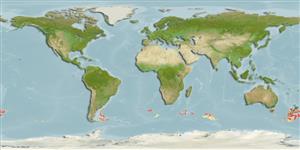
Southern circumglobal: New Zealand, Tasmania, and the Falkland Islands. Also known from the southeast Atlantic off Gough and Discovery tablemounts.
Dimensione / Peso / Età
Maturità: Lm ? range ? - ? cm
Max length : 43.0 cm TL maschio/sesso non determinato; (Ref. 1371)
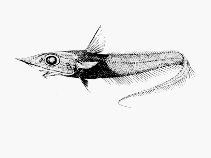
Spine dorsali (totale) : 2; Spine anali: 0. This species is distinguished by the following characters: snout long. Slender, and sharply pointed, its length 43-48% HL, 0.5-0.7 into orbit diameter; normally no scales on ventral aspects of head except along anterolateral margin of snout; naked areas dorsally behind anterolateral margins of snout confined to narrow strips; anterolateral edges of snout not supported by bone (median and lateral processes of nasal bone not united); ventral light organ very small, short, situated just before anus; scales large, fairly deciduous, spinules short, imbricate, aligned in 8 to 10, slightly divergent rows; overall color is gray-brown, with a bluish band around trunk; the underside of the head dusky to densely punctuated; the orbit rim black; the fins blackish to dusky (Ref. 1371, 36027).
Body shape (shape guide): elongated; Cross section: circular.
Feeds on deep-sea decapod crustaceans, gastropods, and polychaetes (Ref. 1371). Probably taken occasionally in by-catch of commercially important fishes (Ref. 1371).
Ciclo vitale e comportamento di accoppiamento
Maturità | Riproduzione | Deposizione | Uova | Fecondità | Larve
Iwamoto, T. and E. Anderson, 1994. Review of the grenadiers (Teleostei: Gadiformes) of southern Africa, with descriptions of four new species. Ichthyol. Bull. J.L.B. Smith Inst. Ichthyol. (61):1-28. (Ref. 11953)
Stato della Lista Rossa IUCN (Ref. 130435: Version 2025-2 (Global))
Minaccia per l'uomo
Harmless
Usi umani
Pesca: di nessun interesse
Strumenti
Rapporti speciali
Scarica XML
Fonti Internet
Stime basate su modelli
Temperatura preferita (Fonte Biblio.
123201): 2 - 7.7, mean 4.3 °C (based on 86 cells).
Indice di diversità filogenetica (Fonte Biblio.
82804): PD
50 = 0.5000 [Uniqueness, from 0.5 = low to 2.0 = high].
Bayesian length-weight: a=0.00257 (0.00132 - 0.00501), b=3.19 (3.02 - 3.36), in cm total length, based on LWR estimates for this Genus-body shape (Ref.
93245).
Livello trofico (Fonte Biblio.
69278): 3.3 ±0.46 se; based on food items.
Resilienza (Fonte Biblio.
120179): Basso, tempo minimo di raddoppiamento della popolazione 4.5 - 14 anni (Preliminary K or Fecundity.).
Vulnerabilità della pesca (Ref.
59153): Low to moderate vulnerability (33 of 100).
🛈