Klassifizierung / Names
Namen | Synonyme | Catalog of Fishes(Gattung, Arten) | ITIS | CoL | WoRMS | Cloffa
>
Perciformes/Cottoidei (Sculpins) >
Cottidae (Sculpins)
Etymology: Alpinocottus: Name from Latin words 'alpinus' for alpine or mountain and 'cottus' meaning sculpin; translation for 'Alpine sculpin', the common name of type species of this genus.
More on author: Heckel.
Umwelt: Milieu / Klimazone / Tiefenbereich / Verbreitungsgebiet
Ökologie
; süßwasser; brackwasser demersal; tiefenbereich 0 - 15 m (Ref. 58496). Temperate; 72°N - 36°N, 10°E - 171°E
Europe and Asia: Streams in Carpathians draining to Danube, Dniestr, Vistula and Odra. Baltic Sea basin, especially in northern Sweden and Finland between 64 and 68°N, central Finnish lakes area, a few streams in southern Finland and northern Poland, Lake Ladoga and southern Lake Onega basins, a few lakes in northern Germany (extirpated), Lake Hañcza in Poland and Skjernaa drainage in Denmark. In Siberia from River Ob eastward to River Lena. Absent in rivers draining to Baltic Sea south of Iijöki drainage in central Finland and in rivers draining to the White and Barents Seas. Cottus populations from the Kolyma, Amur and Korean drainages usually identified as Cottus poecilopus belong to a different species.
Länge bei der ersten Reifung / Größe / Gewicht / Alter
Geschlechtsreife: Lm 9.0, range 4 - 10 cm
Max length : 15.0 cm SL Männchen/unbestimmt; (Ref. 4698); common length : 11.8 cm TL Männchen/unbestimmt; (Ref. 35840); max. veröff. Alter: 8 Jahre (Ref. 4698)
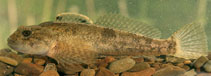
Afterflossenweichstrahlen: 13 - 15. Differs from all other species of Cottus in Europe by possessing spatulate prickles; pelvic-fin rays tessellated, with 5-15 distinct rows of spot, appearing as transverse bands; and 2 chin pores. Additional characters useful in the identification of this species include: lateral line clearly above midline of body (shared only with C. koshewnikowi); lateral line clearly above midline of body; lateral line incomplete, usually reaching to anal-fin base; and prickling restricted to body under pectoral fin (Ref. 55856).
Body shape (shape guide): elongated.
Inhabits northern, and mountain and foothill streams, and oligotrophic lakes. Found in fast-flowing waters of coastal streams, rivers, inland lakes, usually on stony bottoms (Ref. 4698). Moves downstream to estuaries and tolerates brackish waters (Ref. 4698). Feeds on algae (diatoms, desmids, blue-green algae), polychaetes, crustaceans, aquatic insect larvae and nymphs (Ephemeroptera, Trichoptera, Plecoptera, Chironomidae), fish eggs and larvae.
Females spawn onces a season. Most individuals spawn 2-3 seasons. They lay adhesive eggs in a compact clutch on ceiling of small cavities in gravel or rock bottom. Males guard eggs until hatching. males may guard egg clutches of several females. (Ref.59043).
Freyhof, J., M. Kottelat and A. Nolte, 2005. Taxonomic diversity of European Cottus with description of eight new species (Teleostei: Cottidae). Ichthyol. Explor. Freshwat. 16(2):107-172. (Ref. 55856)
IUCN Rote Liste Status (Ref. 130435: Version 2025-2 (Global))
Bedrohung für Menschen
Harmless
Nutzung durch Menschen
Köder: usually
Tools
Zusatzinformationen
Download XML
Internet Quellen
Schätzungen auf der Grundlage von Modellen
Phylogenetischer Diversitätsindex (Ref.
82804): PD
50 = 0.7500 [Uniqueness, from 0.5 = low to 2.0 = high].
Bayesian length-weight: a=0.00692 (0.00404 - 0.01184), b=3.13 (2.98 - 3.28), in cm total length, based on LWR estimates for this species & (Sub)family-body (Ref.
93245).
Trophische Ebene (Ref.
69278): 3.0 ±0.34 se; based on food items.
Generation time: 4.7 ( na - na) years. Estimated as median ln(3)/K based on 2
growth studies.
Widerstandsfähigkeit (Ref.
120179): mittel, Verdopplung der Population dauert 1,4 - 4,4 Jahre. (tmax=8).
Anfälligkeit der Fischerei (Ref.
59153): Low to moderate vulnerability (33 of 100).
🛈