分類 / 名前
共通名の | 類義語 | Catalog of Fishes(部類, 種) | ITIS | CoL | WoRMS | Cloffa
>
Cypriniformes (Carps) >
Leuciscidae (Minnows) > Leuciscinae
Etymology: Rutilus: Latin, rutilus = reddish (Ref. 45335).
Eponymy: Dr Bengt Fredrik Fries (1799–1839) was a Swedish biologist, entomologist and ichthyologist. [...] (Ref. 128868), visit book page.
環境:環境 / 気候帯 / 深さの範囲 / 分布範囲
生態学
; 新鮮な水; 汽水性の 底生の漂泳性; 深さの範囲 50 - ? m. Temperate; 56°N - 36°N, 22°E - 54°E
Eurasia: Black and Azov Sea basins, absent from Danube and Kuban drainages; landloacked populations in Don, resulting from dam construction; Caspian basin from Terek to Atrek drainages, very rarely in northern Caspian basin (Volga [earlier up to Perm], Ural); Lake Iznik in Sea of Marmara basin in Anatolia.
初回成熟時の長さ / サイズ / 重さ / 年齢
成熟: Lm 46.5, range 43 - 50 cm
Max length : 70.0 cm TL オス/雌雄の選別がない; (Ref. 556); common length : 60.0 cm TL オス/雌雄の選別がない; (Ref. 6111); 最大公表体重: 8.0 kg (Ref. 59043); 最大記録サイズ: 12 年 (Ref. 6111)
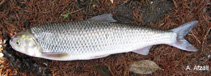
背鰭 (合計) : 11 - 12; 臀鰭: 12 - 14. Can be diagnosed from its congeners in Black and Caspian Sea basins by having the following characters: body almost cylindrical, depth 19-26% SL; 53-64 + 3 scales on lateral line; abdomen posterior to pelvic rounded; snout rounded, stout; mouth subterminal; dorsal fin with 9-10½ branched rays; iris and fins grey or slightly yellowish; breeding males with large, scattered tubercles on top and side of head (Ref. 59043).
Body shape (shape guide): fusiform / normal; Cross section: circular.
A semi-anadromous species which occurs in large brackish estuaries and their large, freshened plume waters, coastal lakes connected to rivers and lowland stretches of large rivers. Can tolerate salinities up to 7-12 ppt. Landlocked populations live in lakes or reservoirs. Larvae and early juveniles take zooplankton, algae and insect larvae as food while adults feed on molluscs, Rhithropanopeus crabs and other benthic invertebrates. Feeding ceases while migrating, spawning and overwintering. Breeds in small rivers or streams with heavy current on gravel bottom. Begins migration to rivers in second half of October (Black Sea, rarely in Caspian Sea). When rivers are covered with ice, spawning migration stops and continues when ice breaks up or even under ice in February-April. Spawns in April-May. Adults migrate back to estuaries to forage immediately after spawning. Juveniles move to estuaries during first summer in August. Landlocked populations undertake migration in springs from lakes or reservoirs or middle stretches of rivers to tributaries or upper reaches (Ref. 59043).
ライフサイクルと交尾行動
成熟 | 繁殖 | 放精 | 卵 | 生産力 | 幼生
Lays eggs which adhere to rocks and gravel, rarely on submerged plants. Eggs hatch in 10-16 days at 12-19°C (Ref. 59043).
Kottelat, M. and J. Freyhof, 2007. Handbook of European freshwater fishes. Publications Kottelat, Cornol and Freyhof, Berlin. 646 pp. (Ref. 59043)
IUCNのレッドリストの状況は (Ref. 130435: Version 2025-2 (Global))
人間の用途
水産業: 商業; 水産養殖: 商業
用具
特記事項
XMLをダウンロードして下さい
インターネットの情報源
モデルに基づく推定値
系統多様性指数 (参照
82804): PD
50 = 0.5020 [Uniqueness, from 0.5 = low to 2.0 = high].
Bayesian length-weight: a=0.00832 (0.00525 - 0.01318), b=3.09 (2.96 - 3.22), in cm total length, based on LWR estimates for this species & (Sub)family-body (Ref.
93245).
栄養段階 (参照
69278): 3.6 ±0.0 se; based on diet studies.
Generation time: 2.7 ( na - na) years. Estimated as median ln(3)/K based on 1
growth studies.
回復力 (参照
120179): 低い, 4.5年~14年の倍増期間の最小個体群 (tmax=12; tm=3-5).
漁業の脆弱性 (Ref.
59153): Low to moderate vulnerability (33 of 100).
🛈
栄養素 (Ref.
124155): Calcium = 8.15 [5.12, 17.31] mg/100g; Iron = 0.0971 [, ] mg/100g; Protein = 19.1 [16.7, 21.3] %; Omega3 = 0.709 [0.367, 1.396] g/100g; Selenium = 2.5 [0.9, 7.1] μg/100g; VitaminA = 17.2 [6.3, 50.1] μg/100g; Zinc = 0.246 [0.163, 0.435] mg/100g (wet weight); based on
nutrient studies.